

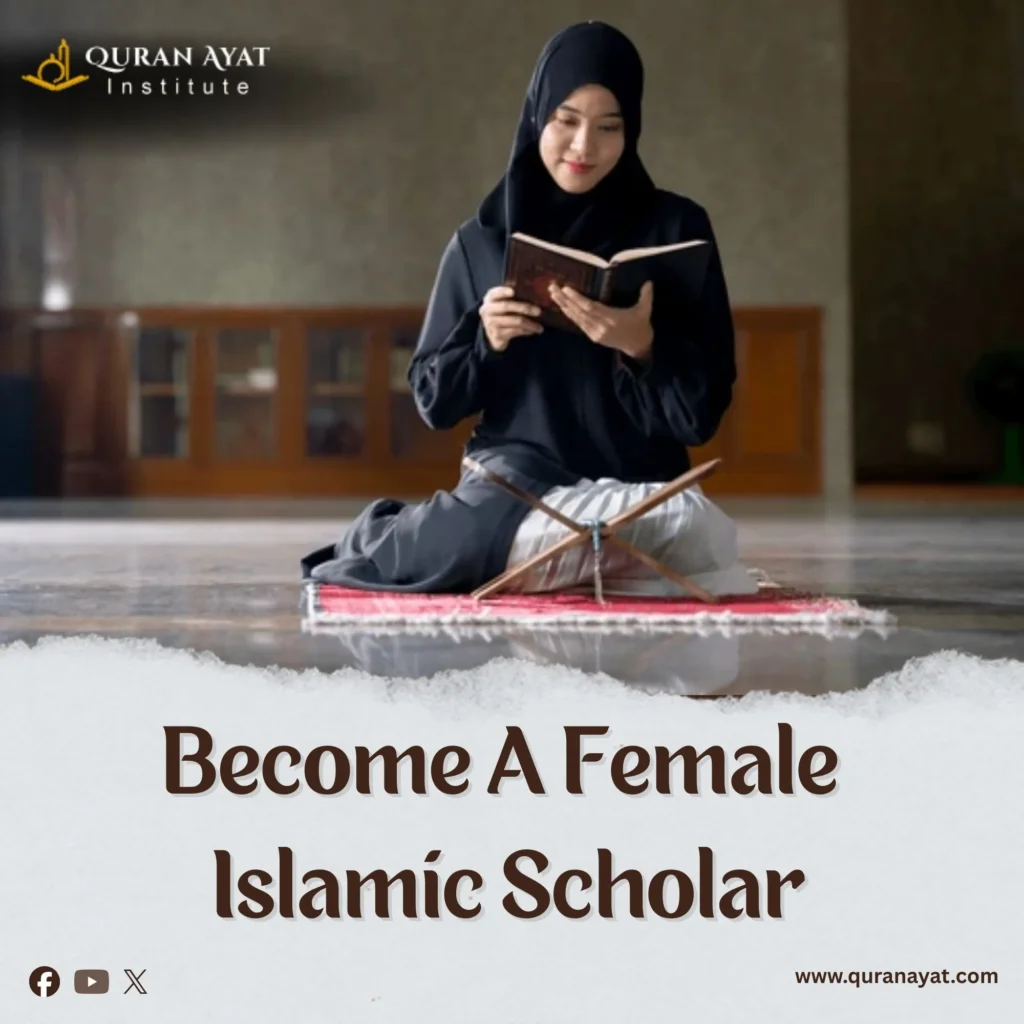
Becoming a female Islamic scholar is an attainable goal for women of all backgrounds and life experiences, not just for those who have dedicated their childhoods to study or memorized the Qur’an at an early age. It encompasses the commitment of women who balance daily responsibilities, such as housework and professional obligations, while actively pursuing knowledge.
The journey involves several steps, including mastering the Arabic language, finding a qualified teacher, creating a study schedule, and ultimately earning an Ijazah. This process transforms an individual from a student into a respected carrier of prophetic knowledge.
Tips to Become a Female Islamic Scholar
The scholars at Quran Ayat Academy are dedicated to sharing some practical tips with the sisters out there to help them choose the right path and follow the guidelines in order to become an Alimah. Let’s delve deep into this topic and learn about these tips one by one.
1. Purify Your Intention
Scholarship in Islam is considered an act of worship. Before engaging with any text, it is important to reflect on your intentions: Is your goal to gain prestige, or are you seeking to please Allah and serve the Ummah? Renewing this intention on a daily basis is essential, as the journey of seeking knowledge can be lengthy. Sincerity in your purpose is what draws blessings into your time and efforts.
2. Hire a Private Tutor for the Basics
Self-study can be an appealing option for learning about the Quran and the Arabic language; however, many of its details may be overlooked without the guidance of a teacher. For beginners, engaging a female tutor for personalized one-on-one sessions is the most effective way to learn Tajweed, which focuses on correct pronunciation. This approach helps ensure that you develop a solid foundation, minimizing the risk of forming incorrect habits early on.
Note: In this regard, the best way out is to take the Noorani Qaida course at Quran Ayat, where sisters can build a solid foundation for the Quran reading and recitation.
3. Enroll in a Formal Alimah Course
To be a scholar, you cannot just pick random topics. You need a structured curriculum, often referred to as the Dars-e-Nizami (or a modern equivalent). These programs usually last 4 to 6 years.\ depending on the sisters’ availability and preferred plan.
Look for reputable online or local institutes that offer online Alima classes. You can get a flexible plan from them to follow the curriculum as per your capacity. The way they handle the Alima course is highly professional, and the curriculum touches all the categories of Islamic Studies.
4. Master the Arabic knowledge.
To achieve a profound understanding of scholarship, it is essential to engage directly with the original texts rather than relying solely on translations. During the initial two years of your studies, it is crucial to concentrate on mastering Nahu (Grammar) and Sarf (Morphology) of Arabic. This foundation will help you build a robust vocabulary, enabling you to read classical works such as Riyad as-Salihin (a well-known book of Hadith) in its original language.
5. Create a Schedule and stick to it.
A scholar’s daily routine is characterized by discipline and structure. It’s important to approach your studies with the same seriousness as a job or a formal degree. One key recommendation is to utilize the early morning hours following Fajr for memorization, as this time is often quiet and conducive to focused study.
Additionally, allocating a Deep Work Block of two hours in the evening can be very effective for immersing yourself in subjects such as grammar and jurisprudence (Fiqh).
Finally, prioritize consistency in your studies over intensity. Regular, steady efforts in your learning will yield more sustainable results than hectic, long-hours study can.
6. Focus on Women’s Jurisprudence (Fiqh)
In many communities, female scholars are frequently sought after for their expertise on subjects unique to women, including purification (Taharah), marriage, and inheritance. A thorough understanding of these aspects of Fiqh is crucial for fulfilling your responsibilities effectively as a leader in these matters.
Mastery of these topics not only equips you to provide guidance but also strengthens your role in the community. Keep yourself enlightened with topics related to fiqh so you can helpout others sisters as an Alimah.
7. Study the Science of Hadith and Tafsir
To deepen your understanding of Islamic texts, it is essential to progress from merely reading to critically analyzing them. This transition requires a strong foundation in two key disciplines:
-
Usul al-Hadith:
This is the science of understanding and verifying the authenticity of sayings attributed to the Prophet Muhammad, PBUH. You must learn to distinguish between authentic Hadith (sahih) and those that are weak (da’if) or fabricated (mawdu’). Understanding the criteria used by scholars—such as the chain of narrators (isnad) and the content (matn) of the Hadith—is crucial for ensuring that the teachings you follow are reliable and accurate.
-
Usul al-Tafsir:
This discipline guides the interpretation of the Quran, ensuring that one engages with the text in a way that respects its divine origin. You need to familiarize yourself with the methodologies that scholars use to interpret Quranic verses, such as linguistic analysis, historical context, and the objectives of Sharia.
8. Build a Support System
Embarking on the journey of knowledge can sometimes feel isolating. To enhance your learning experience, consider joining online group classes specifically for Alimah students. Collaborating with a “study buddy” is crucial for maintaining motivation, especially during challenging topics. Engaging in conversations in Arabic or reviewing Fiqh rulings together can significantly enrich your understanding and keep you on track.
9. Character Development (Tazkiyah)
Knowledge, when not accompanied by strong character (Adab), can lack depth and substance. It is beneficial to explore the biographies of renowned female scholars such as Aisha bint Abi Bakr and Amra bint Abdur-Rahman. Their lives exemplify the importance of a scholar’s hidden qualities, such as their dedication to prayer, acts of kindness, and modest demeanor, which should ideally mirror the knowledge they acquire from their studies.
10. Aim for an Ijazah (Authorization)
In the Islamic tradition, an Ijazah is a certificate that links you to a chain of scholars going back to the Prophet (PBUH). Ensure your chosen program provides a recognized Sanad (chain). This permits you to teach others and ensures the authenticity of the knowledge you pass on.
Conclusion
The title of Alimah is the beginning of a life of service. As a fresher, don’t be overwhelmed by the 6-year road ahead. Focus on today’s lesson, today’s page of the Quran, and today’s vocabulary list. Stay consistent, stay connected to the books and literature, and gain knowledge from different modes of instruction to enhance your perspective and vision. Your journey might be long, but worth the hard work.
You can consider joining online islamic classes at Quran Ayat to smoothly complete the journey with a certified female scholar.
