

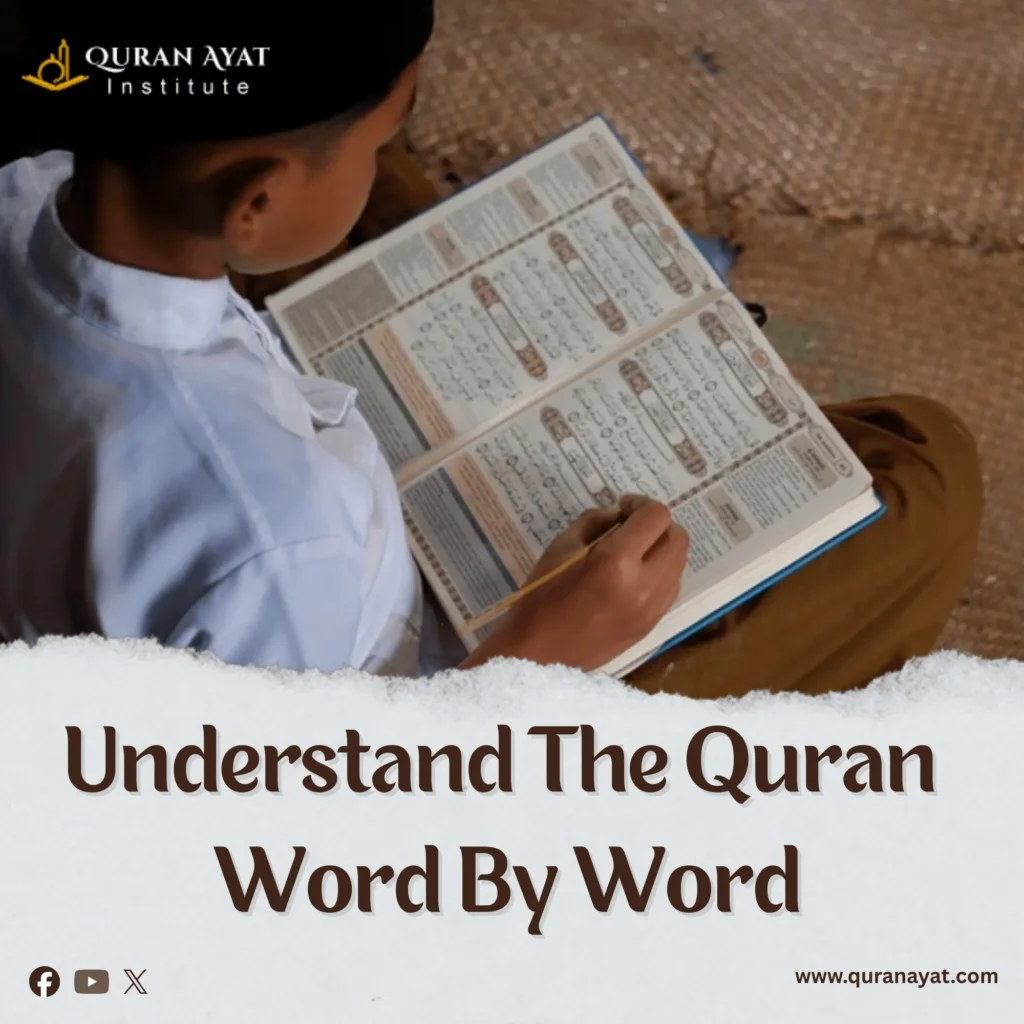
Understanding the Quran word-for-word is the key to unlocking a deeper connection with the Divine message. When you shift from reading a broad translation to analyzing individual terms, you begin to appreciate the precision of Arabic root words and the emotional weight behind every verse. By focusing on root word identification, utilizing specialized word-for-word translations, and perhaps by seeking formal guidance, you transform your recitation from a ritual into a profound intellectual and spiritual dialogue.
10 Tips to Understand the Quran Word-by-Word
The tutors at Quran Ayat Academy have listed some tips to understand the Quran word by word. As a beginner, you can get benefits from this guide.
1. Master the Root Word System
Arabic is structured around a unique 3-letter root system. By identifying a root—such as K−T−B, which relates to writing—you can easily uncover a variety of associated words, or “family members.” For example, from this root, we find Kitab (book), Kataba (he wrote), and Maktaba (library). Learning just one root can open the door to understanding many related words, significantly enhancing your vocabulary.
2. Focus on High-Frequency Vocabulary
The Quran comprises approximately 77,000 words, with many of them being repeated throughout the text. Notably, around 300 words make up about 70% of the entire content. By focusing on these frequently used “power words”—such as Inna, Qul, and Allah—you can expect to recognize a significant portion of the text, potentially becoming familiar with half of each page in just a few weeks.
3. Use a “Lafzi” (Literal) Translation
Standard translations typically adjust sentence structures to improve readability in English. In contrast, a “Lafzi” or word-for-word translation maintains the original order of the Arabic text. This method allows readers to clearly identify how each English concept corresponds to specific Arabic terms, emphasizing the precise intentions behind the original message.
4. Deconstruct Prefixes and Suffixes
Arabic words often function as compact sentences, with a single term capable of encompassing various grammatical elements. For instance, a single word can include a preposition, a verb, and an object. Take the word Walyaktub as an example: the prefix “Wa” translates to “and,” “li” signifies “should,” and “yaktub” means “he writes.” Understanding how to “peel” back these layers is essential for achieving clarity at the word level in the Arabic language.
5. Seek Formal Guidance and Context
Individual words can change meaning based on the verse’s historical background. To ensure you aren’t just translating but truly understanding, consider enrolling in an Online Tafseer Course. Expert guidance helps you navigate linguistic nuances and the “Asbab al-Nuzul” (reasons for revelation).
6. Maintain a “Word-Profile” Journal
To enhance your vocabulary retention, consider documenting your learning process rather than simply reading. Each day, select one challenging word to focus on. Record its root and identify its grammatical category, such as whether it is a noun or a verb. Additionally, note other verses or contexts in which the word appears. This active engagement helps transfer the word from your short-term memory to your long-term vocabulary, making it more integral to your language skills.
7. Start with the Short Surahs (Juz Amma)
The 30th part of the Quran, often referred to as the Juz Amma, consists of shorter verses that are rich in rhythmic patterns and evocative language. These verses are commonly recited during daily prayers, allowing individuals to practice word recognition and improve their understanding five times a day. This frequent exposure enhances familiarity with the text and supports language development within the context of spiritual practice.
8. Sync Auditory and Visual Learning
Use a digital Quran tool that highlights each word as a reciter speaks it. This “multisensory” approach forces your brain to bridge the gap between the written script and the spoken sound, preventing your eyes from skimming over difficult words.
9. Learn Basic “Sarf” (Morphology) Scales
Arabic words follow predictable “scales” or templates (Awzan). If you learn the scale for a “Place,” the root S−J−D (prostrate) automatically becomes Masjid (a place of prostration). Recognizing these patterns allows you to decode the meaning of words you’ve never seen before.
10. The Rule of Five
To prevent burnout, prioritize quality over quantity in your study approach. Rather than attempting to cover an entire page, concentrate on mastering five specific words from a single verse. This slow and deliberate method of study fosters a much more solid foundation compared to hurriedly progressing through multiple chapters. Taking the time to truly understand each word will enhance your overall comprehension and retention of the material.
Conclusion
Understanding the Quran word-for-word is a journey that transforms your relationship with the Creator. It turns a beautiful recitation into a direct, vivid conversation. While the task may seem daunting at first, using these structured tips will allow you to see the precision of every Harf and the infinite wisdom behind every word choice. Enroll in a structured online quran recitation course by Quran Ayat, where the translation and recitation is done word-by-word through grammar being focused.
