

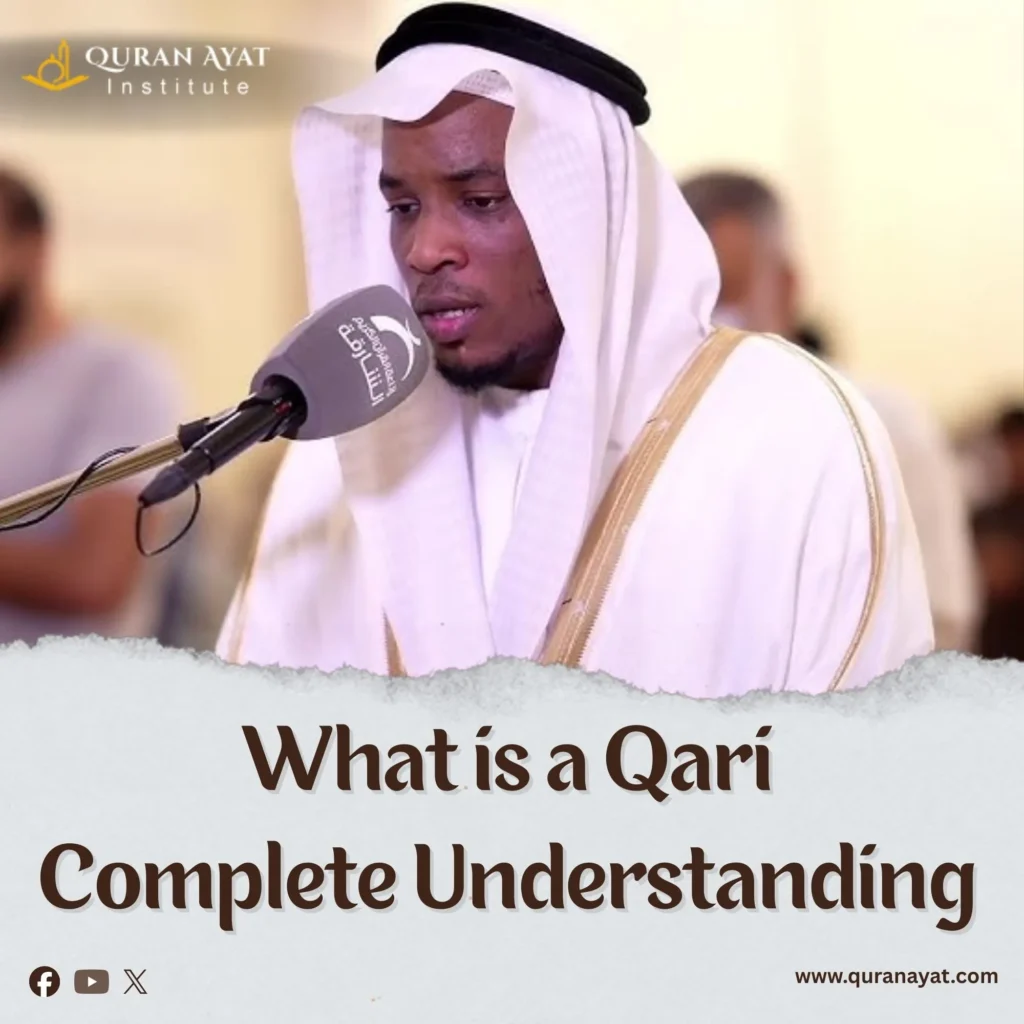
The Holy Quran is not merely a book to be read; it is a revelation to be experienced. When the verses of Allah are recited with the correct rhythm, pronunciation, and soul, they have the power to soften the hardest hearts and bring tears to the eyes of the faithful. This sacred art of beautiful recitation is the domain of the Qari.
Becoming a Qari is one of the most noble spiritual journeys a Muslim can undertake. You need to master the tajweed rules, practice recitation daily, record your recitation, and get guidance from a professional. Let’s delve deep and learn who a qari is and how a muslim can become a qari online.
What is a Qari?
In the Arabic language, the word Qari (plural: Qurra) literally means a reader. However, in Islamic scholarship, the title carries much more weight. A Qari is a master of Tajweed and makharij.
Historically, the Qurra were the guardians of the Quran. Before the Quran was widely compiled into written books, it lived in the chests and voices of the Qaris. Today, a Qari is someone who:
- Maintains the authentic chain of narration (Sanad) back to the Prophet (PBUH).
- Balances technical precision with emotional delivery (Khushu).
- Inspires the community to engage more deeply with the Quran through the beauty of their voice.
How to Become a Qari of Quran Online?
Becoming a professional Qari requires more than just a good voice; it requires discipline, methodology, and spiritual sincerity. Here are some helpful tips to become a Qari online.
1. Master the Foundations of Tajweed
Building a strong foundation is essential for any structure, and the same principle applies to reading and reciting. Before delving into the intricacies of melody, it is crucial to establish a solid understanding of key rules, such as Noon Sakinah, Meem Sakinah, and the different types of Madd (prolongation). Mastering these elements is essential, as precision in pronunciation distinguishes a skilled Qari from a casual reader.
2. Learn Under a Qualified Teacher
The Quran is an oral tradition. It cannot be learned in isolation or solely from YouTube videos. You need a teacher who can listen to your breath, correct your tongue placement, and identify mistakes you might not even hear yourself making.
To begin your own path toward this mastery, consider enrolling in online Quran Recitation Classes by Quran Ayat, where expert tutors guide you through the Tajweed and recitation of every verse.
3. Practice Breath Control (Breathing Exercises)
A proficient Qari is able to recite extended passages seamlessly, which relies heavily on the technique known as “diaphragmatic breathing.” This approach involves inhaling deeply into the abdomen rather than the chest, allowing for sustained vocalization of longer notes and ensuring a consistent rhythm throughout the recitation. Practicing this type of breathing can enhance one’s ability to maintain flow and control during performance.
4. Listen to the “Golden Generation.”
Immersion in the art of recitation is essential for mastering the technique. Dedicate significant time to listening to renowned reciters such as Sheikh Mahmoud Khalil Al-Hussary, who is known for his precision, and Sheikh Abdul Basit ‘Abd us-Samad, recognized for his exceptional breath control and tone. Pay close attention to their stylistic pauses and the transitions they make between high and low notes, aiming to mimic these qualities in your own practice.
5. Record and Self-Critique
To improve your recitation of the Quran, consider recording yourself reading a page and then playing it back alongside a master Qari’s recitation of the same page. This exercise, known as “gap analysis,” allows you to pinpoint areas where your pronunciation or rhythm may need improvement. By comparing your recitation with that of a skilled Qari, you can enhance your skills and develop a better understanding of the nuances of proper recitation.
6. Understand the Meaning (Tafsir)
In order to convey genuine emotion in a verse, it’s essential to understand its meaning fully. For example, when reciting verses about Paradise, one should strive for a tone that communicates joy and hope. Conversely, when discussing the Day of Judgment, the delivery should embody awe and humility. Understanding the emotional context of the verses can significantly enhance the effectiveness of the recitation.
7. Consistency Over Intensity
It is better to practice for 30 minutes every day than 5 hours once a week. The muscles in your throat and your memory require daily reinforcement to adapt to the complex phonetics of Quranic Arabic.
8. Purify Your Intentions (Niyyah)
The Prophet (PBUH) warned that the first people to be judged on the Day of Resurrection include a man who recited the Quran so people would call him a “Qari.” Always remind yourself that you are beautifying your voice for the sake of Allah, not for the applause of people.
Conclusion
The path to becoming a Qari is a journey of a lifetime. It is a path filled with blessings, peace, and a unique closeness to the Creator. At Quran Ayat, we are dedicated to helping you find your voice with our online qirat course. Whether you are starting from the basics of the Arabic alphabet or are ready to dive into advanced Tajweed, our doors are open.
