
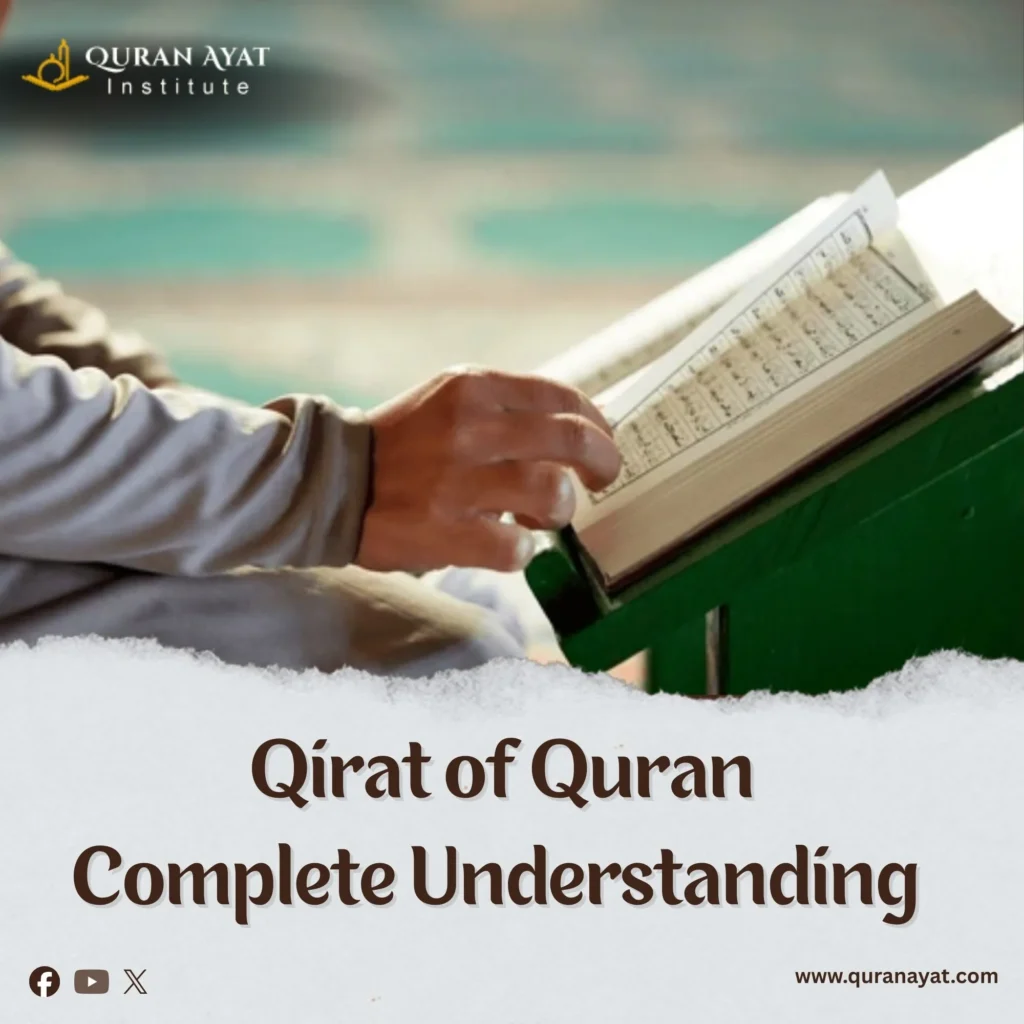
The Quran is not merely a book to be read; it is a divine melody to be heard, preserved, and felt. While many are familiar with Tajweed, there exists a deeper, specialized science known as Qira’t. Qira’at are actually various authentic styles of recitation revealed to the Prophet Muhammad, PBUH, to accommodate different dialects and linguistic nuances.
At Quran Ayat, we believe that understanding Qira’at is the key to appreciating the miraculous preservation of Allah’s word. Through a structured Qirat course, students can gain deeper insight into these authentic recitations and strengthen their connection with the Quran.
Qirat of Quran Meaning
The word Qirat (plural: Qira’at) is derived from the Arabic root Qara’a, meaning “to read” or “to recite.” Linguistically, it refers to the act of recitation. Technically, in Islamic sciences, Qira’at refers to the various methodologies of reciting the Quran as transmitted by a recognized Imam through a continuous, authentic chain of narrators reaching back to the Prophet Muhammad, PBUH.
Qira’t involves variations in vowels, consonants, and sometimes word forms, all of which were divinely permitted to ease the recitation for different Arab tribes while maintaining a singular, unified message.
Types of Qirat in Quran Recitaton
While many people have heard of the “7 Qira’at,” scholars do recognize 10 authentic Qira’at. Each Qirah is named after the master reciter (Imam) who codified it.
The Seven Canonical Qira’at:
- Nafi’ Al-Madani (Madinah): Famous in North and West Africa. Its most well-known narrators (Rawis) are Warsh and Qalun.
- Ibn Katheer Al-Makki (Makkah): Known for its clarity and connection to the dialect of the Quraysh. Transmitted by Al-Bazzi and Qunbul.
- Abu Amr Al-Basri (Basra): Notable for its gentle rhythm and subtle pauses. Transmitted by Ad-Duri and As-Soosi.
- Ibn Aamir Ash-Shami (Syria): A strong, deep style common in historical Damascus. Transmitted by Hisham and Ibn Dhakwan.
- Asim Al-Kufi (Kufa): The most widespread style in the world today. Transmitted by Hafs (the standard for most Mushafs) and Shu’bah.
- Hamzah Al-Kufi (Kufa): Known for its precise pauses and distinct lengthening. Transmitted by Khalaf and Khallad.
- Al-Kisa’i Al-Kufi (Kufa): Emphasizes unique vowel pronunciations and linguistic elegance. Transmitted by Al-Layth and Ad-Duri.
The Three Supplementary Authentic Qira’at:
- Abu Ja’far Al-Madani: Similar to Nafi’, focusing on the Madinan tradition.
- Ya’qub Al-Hadrami: Known for its rigorous adherence to Arabic grammar rules.
- Khalaf Al-Bazzar: A distinct extension of the Kufan school of recitation.
Why is Qirat Important?
Understanding the types of Qira’at is not just for scholars; it benefits every believer.
- Proof of Preservation:
The fact that 10 different styles exist with unbroken chains proves that the Quran was preserved orally and in writing with absolute precision.
- Richer Meaning:
Subtle variations in words (e.g., Maaliki vs. Maliki in Surah Al-Fatiha) provide layers of meaning that complement each other.
- Linguistic Miracle:
It showcases the vastness and flexibility of the Arabic language, making the Quran accessible to various cultures and tongues.
- Spiritual Connection:
Every Qirah offers a unique emotional “flavor,” helping the reciter find a deeper connection with the verses.
Tips to Improve Your Qirat
Improving your Qirat requires a transition from basic reading to artistic mastery. Here are five steps recommended by the Quran Ayat that can help you improve your Qirat and sound like a pro Qari.
- Perfect Your Tajweed:
You cannot learn Qira’at without a rock-solid foundation in Tajweed. Ensure your Makharij are perfect.
- Listen to Master Qaris:
Spend time listening to different styles. For example, listen to Sheikh Khalil al-Husary for Hafs or Sheikh Al-Ayoun Al-Kouchi for Warsh.
- Find a Certified Teacher:
Qira’at is an oral science. You must learn from a teacher who holds an Ijazah (certification) to ensure your chain of narration is correct.
- Record and Compare:
Use technology to record your recitation and compare it with authentic recordings to catch subtle differences in tone and rhythm.
- Be Consistent:
Focus on mastering one Qirah (usually Hafs ‘an Asim) before moving to others to avoid confusion.
Note: You can also enrol in online quran recitation Classes by Quran Ayat to perfect your recitation and master any of the 10 Qirat styles.
Conclusion
The science of Qira’at is a testament to the beauty and depth of the Holy Quran. Whether you are a beginner or looking to master the 10 Qira’at, the journey begins with a single step toward perfection. Join Quran Ayat Academy today! Our expert tutors are ready to guide you through personalized one-on-one sessions to help you recite the Quran exactly as it was revealed.
