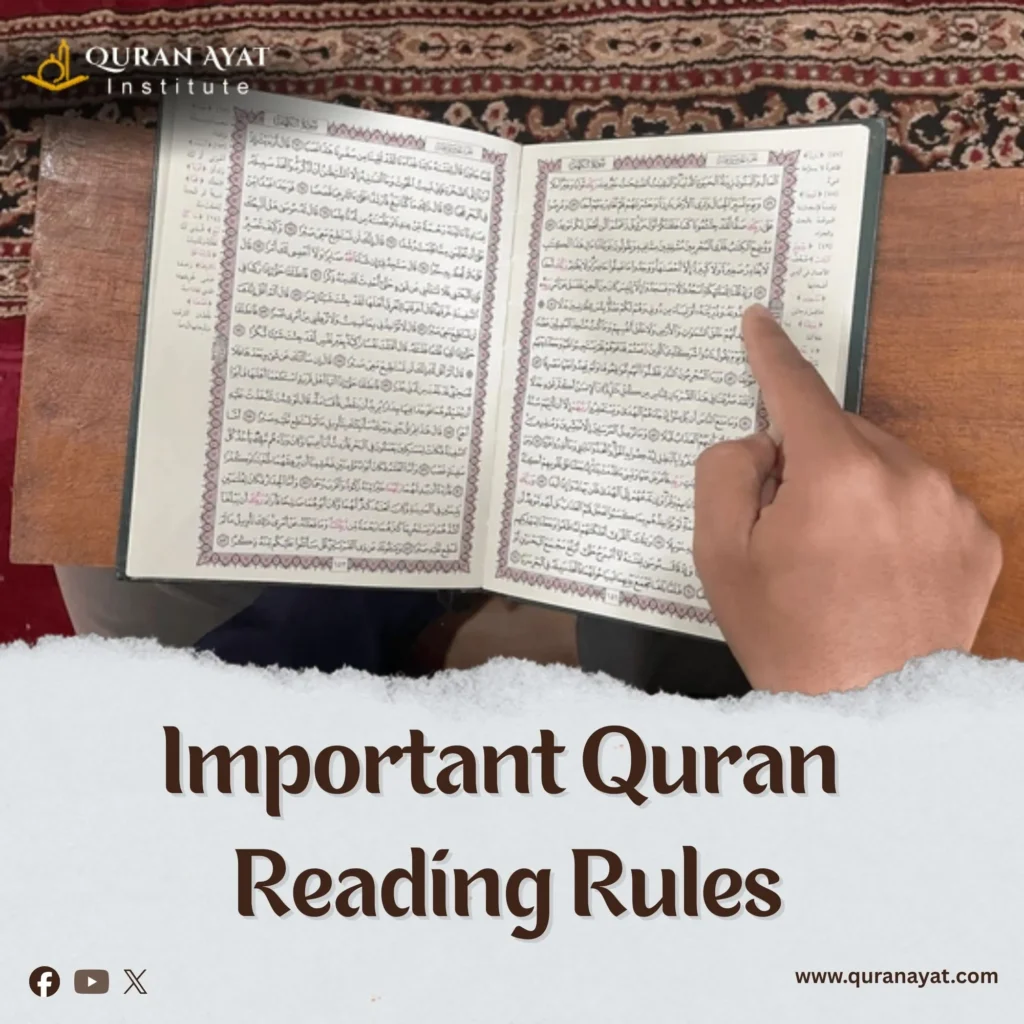
Reading the Quran is a sacred journey, but reciting it with Tajweed transforms that journey into a soul-stirring experience. Tajweed isn’t just a set of technicalities; it is the “science of beautification” that ensures every letter is pronounced from its correct origin with its rightful characteristics. When you master the Quran reading rules, you move beyond simply identifying Arabic letters and begin to preserve the divine rhythm exactly as it was revealed. Let’s explore the rules of reading the Quran with Tajweed in this Blog and beautify our voices with real gems.
10 Essential Quran Reading Rules
The list of rules to read the Quran is listed by the prestigious scholars at Quran Ayat. These rules are good for beginners and kids.
1. Makharij ul-Huroof (The Points of Articulation)
If you want to build a house, you need a solid foundation. In Tajweed, Makharij is the foundation. It identifies exactly where in the mouth or throat a letter is born.
- The Throat: Divided into the deepest, middle, and closest parts (e.g., the deep Hamza vs. the middle Ha).
- The Tongue: 18 letters rely on the tongue touching the teeth, the palate, or the gums.
- The Lips: Letters like Ba, Meem, and Waw are formed here.
- The Nose: This is the “home” of the Ghunnah (nasal sound).
2. Sifaat ul-Huroof (The Characteristics)
Every letter has an “attitude” or “quality.” In Arabic, the siffat (quality) of each letter is different from the other and understanding these siffat is crucial.
- Tafkheem (Heavy): These letters (like Sod, Dhad, Qaf) are pronounced with a full mouth, making the sound thick and powerful.
- Tarqeeq (Light): These letters (like Ba, Ta, Seen) are thin and soft.
- Hams (Whisper): A slight flow of breath when saying letters like Ka or Ta.
3. Noon Sakinah and Tanween
This is perhaps the most famous set of rules. It applies whenever you see a Noon with a Sukoon (نْ) or a Tanween (double vowels ً ٍ ٌ). There are 4 types of this rule.
- Izhaar (Clarification): Pronounce the ‘N’ clearly if the next letter is a “throat letter.”
- Idghaam (Merging): Make the ‘N’ disappear and blend it into the following letter (e.g., Mi-rrabbi-him).
- Iqlab (Conversion): Turn the ‘N’ into a tiny ‘M’ sound if a Ba follows.
- Ikhfa (Hiding): Hide the ‘N’ sound with a 2-beat nasal hum if any of the remaining 15 letters follow.
4. Meem Sakinah
In the science of Tajweed, Meem Saakin refers to a letter Meem (م) that does not carry a vowel (Haraka). This means it has no Fatha, Kasra, or Damma and is instead marked with a Sukoon (مْ) or is written without any sign at all.
When you encounter a Meem Saakin while reading the Quran, its pronunciation is determined by the letter that immediately follows it. There are three specific rules for Meem Saakin.
- Idghaam Shafawi: If a Meem follows another Meem, they merge with a hum.
- Ikhfa Shafawi: If a Ba follows a Meem, the sound is “hidden” in the lips with a hum.
- Izhaar Shafawi: For all other letters, the Meem is pronounced crisp and clear.
5. Sukoon (The Rest)
In Tajweed, Sukoon ( ْ ) is a small circle-shaped symbol placed above an Arabic letter. It represents the absence of a vowel.
While most letters carry a “movement” (Haraka), such as the Fatha (a), Kasra (i), or Damma (u), a letter with a Sukoon is “stationary” or “resting.” It is often referred to as a “dead” letter because it has no vowel sound of its own.
How to Pronounce Sukoon
Because a letter with a Sukoon has no vowel, it cannot be pronounced by itself. It must be linked to the letter preceding it. You pronounce the sound of the letter and then “stop” or “rest” your breath on it.
Example: In the word “Al-Hamdu” (الْحَمْدُ):
- The Lams (لْ) has a Sukoon. You connect the “A” sound to the “L” and stop (Al).
- The Meem (مْ) has a Sukoon. You connect the “Ha” sound to the “M” and stop (Ham).
6. Shadd (The Emphasis)
The Shadd ( ّ ) is a diacritical mark in the Arabic language that signifies the doubling of a consonant. It indicates that two identical letters are to be pronounced in succession, with the first letter carrying a Sukoon (which denotes a lack of a vowel) and the second letter pronounced with a vowel. When articulating a Shadd, it’s important to slightly lengthen the first letter, effectively “pressing” it for a brief moment to enhance its impact in speech.
7. Al-Madd (The Lengthening)
This provides the “melody” of the Quran. Whenever you see a wavy line (~) or a long vowel, you must stretch the sound.
- Short Madd: Usually 2 counts (like a heartbeat).
- Long Madd: Can go up to 4, 5, or even 6 counts, depending on the grammar of the verse.
8. Qalqalah (The Echo)
When the letters ق, ط, ب, ج, د (grouped as Qutub Jadd) have a Sukoon, they must “bounce.” If you stop on these letters without an echo, the sound feels “stuck.” The Qalqalah releases the sound with a beautiful vibration.
9. Ghunnah (The Nasal Hum)
This is a 2-beat vibration that comes strictly from the nose. It is mandatory for any Noon or Meem that carries a Shadd. It adds a haunting, resonant depth to the recitation.
10. Waqf (The Art of Stopping)
Knowing where to stop is as important as knowing how to read. Waqf symbols (like ۚ or ۘ) guide you. Stopping at the right place preserves the breath and, more importantly, the sacred meaning of the sentence.
Ready to Turn Theory into Practice?
Reading about Tajweed is like reading about swimming; you eventually have to get in the water! The best way to master these rules is through “Talaqqi” (face-to-face learning). Join our expert-led online quran recitation Course at Quran Ayat and start your journey toward a perfect, soul-stirring recitation today.
Conclusion
The journey of learning Tajweed is a journey of love. Every Madd you stretch, and every Qalqalah you bounce is a sign of your devotion to the Word of Allah. It might feel like a lot to remember now, but with consistent practice, these rules will become as natural to you as breathing. Take it one verse at a time, and remember: the beauty is in the effort.
