

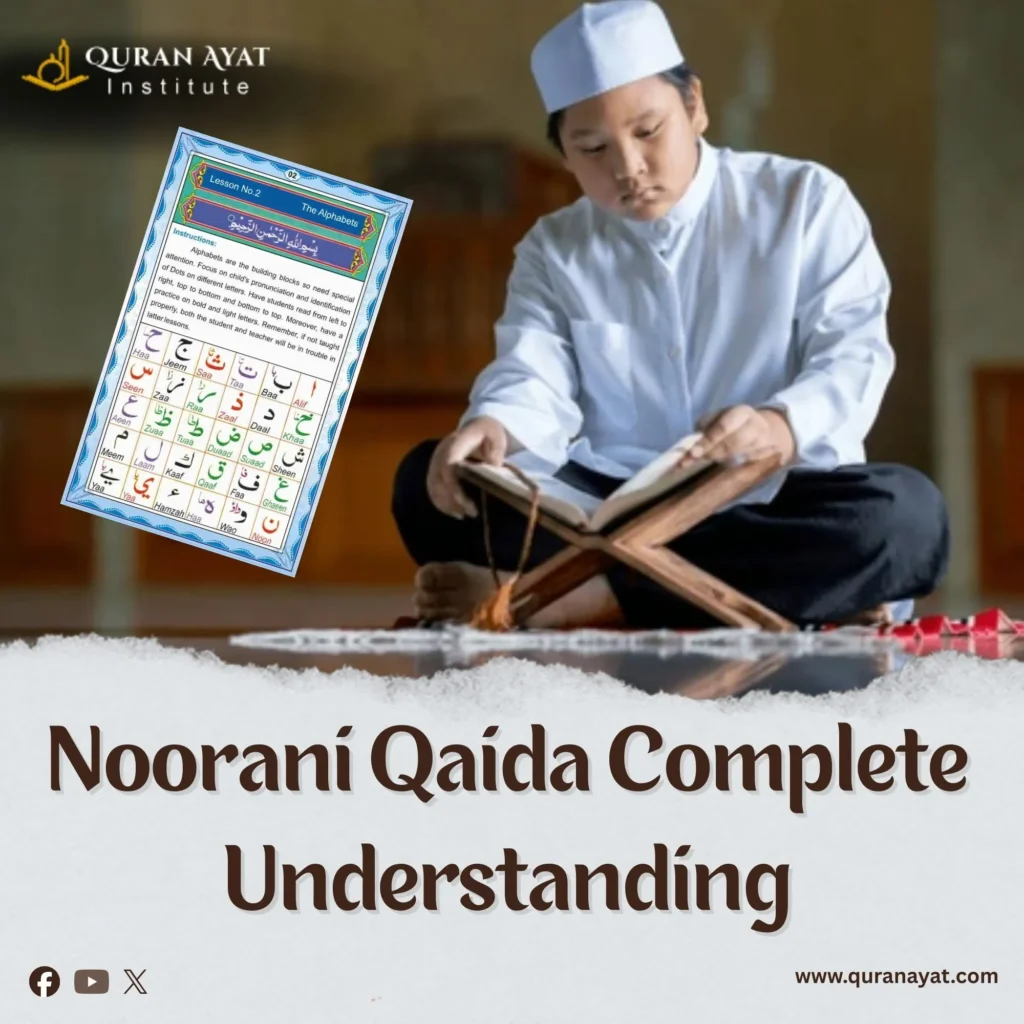
For anyone beginning their journey with the Holy Quran, the first hurdle is often the Arabic script itself. The letters look different, the sounds are unique, and the rules of Tajweed are precise. To overcome this hurdle, scholars developed a specialized booklet that simplifies this complex language into manageable steps. This guide explores Noorani Qaida course, the most trusted manual for Quranic literacy used by students and academies worldwide.
What is Noorani Qaida?
Noorani Qaida is a foundational book designed to teach the Arabic alphabet and the rules of Tajweed to beginners, particularly non-Arabs. It acts as a “pre-Quran” textbook. Instead of focusing on conversational Arabic or vocabulary, it focuses entirely on phonetics. By the time a student finishes this booklet, they possess the ability to look at any word in the Quran and pronounce it correctly, even if they do not yet understand its meaning.
An Overview of the Qaida: The Author and His Mission
The Noorani Qaida was meticulously compiled by Sheikh Noor Muhammad Haqqani (1872–1925 AD), a prominent scholar from India.
During his era, the Sheikh noticed that many students struggled to recite the Quran with the correct “Makharij” (articulation points). He realized that jumping straight into the heavy text of the Quran was overwhelming for children and non-native speakers. He authored this “Qaida” (which means ‘rule’ or ‘foundation’) to provide a scientific, step-by-step method to train the human tongue to produce classical Arabic sounds accurately. His mission was to preserve the authentic recitation of the Quran for generations to come.
Chapters of Noorani Qaida
| Lesson # | Lesson Title | Topic & Learning Objective |
| 1 | Huroof al-Mufradat | Identification of the 28/29 individual Arabic letters and their correct Makhraj. |
| 2 | Huroof al-Murakkabat | Recognizing letters in their various compound forms (beginning, middle, and end of a word). |
| 3 | Huroof al-Muqatta’at | Practicing the disconnected letters found at the start of certain Surahs. |
| 4 | Harakat | Introduction to the short vowels: Fatha (a), Kasra (i), and Damma (u). |
| 5 | Tanween | Learning “Nunation” (double vowels): Fathatain, Kasratain, and Dammatain. |
| 6 | Exercises (Mashq) | Combining Harakat and Tanween to form and read basic words. |
| 7 | Standing Harakat | Mastery of Khadah Zabar, Khadi Zer, and Ulta Pesh (Vertical Vowels). |
| 8 | Huroof al-Maddah o Leen | Rules for stretching (Maddah) and softening (Leen) specific letters. |
| 9 | Review Exercise | A comprehensive practice lesson covering all previous rules (Lessons 1-8). |
| 10 | Sukoon (Jazm) | Learning the “resting” sign and how to link a vocalized letter to a silent one. |
| 11 | Exercises of Sukoon | Advanced practice for connecting sounds fluently. |
| 12 | Tashdeed | The “Shaddah” sign: learning how to emphasize or double a letter’s sound. |
| 13 | Exercises of Tashdeed | Practicing word structures that incorporate the Shaddah sign. |
| 14 | Tashdeed with Sukoon | Combining the rules of doubling and silence within a single word. |
| 15 | Tashdeed with Tashdeed | Complex words containing multiple stressed letters. |
| 16 | Tashdeed with Huroof al-Maddah | Integrating long vowels with the rules of Tashdeed. |
| 17 | Final Review | A summary lesson that prepares the student to transition into reading the Quran. |
Importance of Learning the Qaida
It is often said that the Noorani Qaida is to the Quran what phonics is to English. It isn’t just a “beginner’s book”; it is a precision tool designed to tune the tongue before one ever attempts to recite the Holy Script. Scroll down to understand the importance of this booklet.
1. Precision in Pronunciation (Makhraj)
Arabic is a language where a slight shift in the throat or tongue can change the entire meaning of a word. The Qaida acts as a “vocal gym,” training the student to distinguish between similar-sounding letters, like the deep Haa (ح) in Alhamdulillah versus the soft ha (ه). By fixing these sounds early, the student avoids altering the divine meaning of the text.
2. Strategic “Decoding” and Independence
The goal of the Qaida is to move a student from memorization to literacy. Instead of “reading along” with a teacher or following a melody, the student learns the mechanics of how letters join and how vowels function. Once they master the 17 lessons, they possess the ability to read any verse in the Quran independently, without needing a guide for every new word.
3. Efficiency and Habit Correction
It is significantly easier to spend a few months mastering a 30-page primer than it is to unlearn decades of bad habits. Attempting to read the Quran without this foundation often leads to “stumbling” through verses. The Qaida saves time by addressing phonetic hurdles in isolation, ensuring that when the student finally opens the Quran, their flow is smooth and uninterrupted.
4. A Foundation for Tajweed
Tajweed can be intimidating with its complex terminology. The Noorani Qaida introduces these rules, such as Ghunnah (nasalization), Qalqalah (echoing sounds), and Madd (elongation), through practical rhythm and repetition. It allows the student to absorb the “spirit” of the rules naturally before learning the formal technical names.
Tips to Master Noorani Qaida
Although taking a formal Noorani Qaida course can help you master this booklet with proficiency, here are some useful tips from the tutors of Qurn Ayat Academy. Follow these tips to better understand Qaida.
-
Listen and Repea
Always use “Talaqqi” (the method of listening to a teacher and repeating). Use audio recordings of experts to perfect your rhythm.
-
Focus on the Throat
Arabic is a “guttural” language. Pay close attention to which sounds come from the top, middle, or bottom of the throat.
-
Finger Tracking
Always use your finger or a pointer to follow the letters. This builds a strong visual-to-brain connection.
-
Daily Consistency
Just 10 to 15 minutes of daily practice is far more effective than a two-hour session once a week.
-
Don’t Rush the Early Lessons
Chapters 1 through 4 are the “DNA” of the book. If you master these perfectly, the rest of the book will feel significantly easier.
Conclusion
Noorani Qaida is more than just a book of letters. It transforms the daunting task of learning a new language into a structured and rewarding journey. By honoring the method laid out by Sheikh Haqqani, students can ensure that their recitation of the Holy Quran is beautiful, accurate, and pleasing to Allah. Don’t rush to complete the chapters to begin the Quran, instead spend as much time as possible on each chapter to ensure every rule is at your fingertips.
