
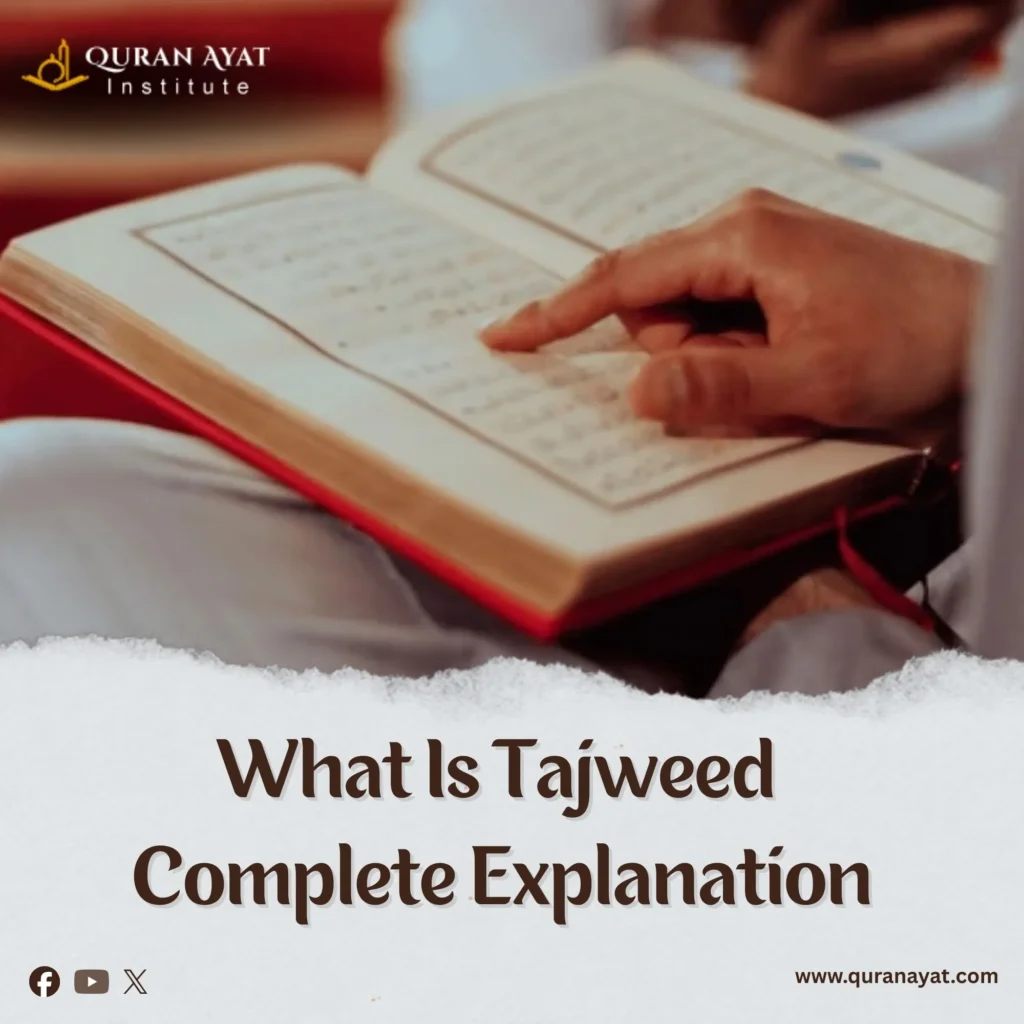
Tajweed is the science of perfecting the recitation of the Quran, ensuring that every letter is pronounced according to its specific rules. For every Muslim, learning Tajweed is the path to preserving the divine message and connecting to the words of Allah with deep reverence. Let’s delve deep into this topic and learn more about tajwid.
Definition of Tajweed
Tajweed (تجويد) is an Arabic word that means “proficiency” or “doing something well.” When applied to the Quran, it refers to the set of rules governing the pronunciation of letters with all their qualities and applying the correct rhythms. It ensures that every letter is given its due right (Makhraj) and its specific characteristics (Sifaat), preserving the integrity and melody of the revelation.
The History of Tajweed
The history of Tajweed is as old as the Quran itself, beginning with the Angel Jibreel (AS) reciting the revelation to Prophet Muhammad PBUH in a specific, rhythmic manner. In the early days of Islam, the Sahaba (companions) recited naturally with perfect tajwid because it was their native tongue. However, as Islam spread to non-Arabic-speaking lands, the risk of “linguistic pollution” and mispronunciation grew. To protect the sanctity of the text, scholars in the 2nd and 3rd centuries AH—most notably Abu Ubaid al-Qasim bin Salam—began codifying these oral practices into a formal science.
This transition from a natural intuition to a structured discipline ensured that the exact sounds, echoes, and stretches used by the Prophet (ﷺ) would be preserved perfectly for every generation to come.
Importance of Tajweed For Quran Recitation
The importance of reciting with care isn’t just a linguistic preference; it is a direct instruction found within the Quran itself. Allah (SWT) says:
“…and recite the Quran with measured recitation.” (Surah Al-Muzzammil, 73:4)
This verse serves as the foundation for the science of Tajweed, encouraging us to move beyond mere reading into a state of rhythmic reflection. Many beginners ask if Tajweed is simply a “bonus” for beautiful recitation or if it is a necessity. In reality, Tajweed is the shield that protects the Quran from the passage of time and human error. Here is why it is considered vital:
1. Guarding the Word of Allah
The Quran is the literal word of Allah (SWT). Unlike other books, the sound and delivery are part of the revelation itself. Tajweed ensures that we do not add, remove, or change the essence of the divine speech. It keeps the oral tradition “pure” and identical to how it was revealed over 1,400 years ago.
2. Avoiding Major Mistakes (Lahn Jali)
In the Arabic language, a small slip of the tongue can change a word’s meaning entirely. Changing the letter Ha (ح) to a different Ha (ه) can turn the word “Al-Heleem” (The Forbearing) into a word with no meaning or a wrong meaning.
Tajweed prevents these “Major Mistakes” (Lahn Jali), which could potentially invalidate a person’s prayer if the meaning of a Surah is corrupted.
3. Spiritual Beauty and Etiquette
Reciting the Quran is an act of worship. Just as we perform Wudu (ablution) to clean our bodies before prayer, tajwid “cleans” our speech before we recite. It is an act of respect and Adab (etiquette) toward the Creator to put effort into pronouncing His words correctly and beautifully.
4. Psychological and Heart Impact
There is a unique tranquility (Sakinah) that descends when the Quran is recited with proper Tajweed. The specific rhythms of lengthening (Madd) and nasalization (Ghunnah) are designed to move the heart. When the rules are applied, the recitation reaches a level of melody that can bring tears to the eyes and peace to the soul.
5. Fulfilling an Individual Obligation
Many scholars consider learning the basic rules of Tajweed (to avoid changing the meaning) as Fard al-Ayn (an individual obligation) for every Muslim. While mastering the most complex technicalities is Fard al-Kifayah (a communal obligation), every believer is encouraged to strive for “correctness” in their daily prayers.
10 Main Rules of Tajweed
To master the art of recitation, students typically focus on these ten foundational pillars. These rules govern how sounds interact, blend, or stay distinct.
Makharij al-Huruf (Points of Articulation)
The “where” of the sound. This is learning exactly where in the mouth, throat, or lips each of the 28 Arabic letters originates.
Sifaat al-Huruf (Characteristics of Letters)
The “how” of the sound. Does the letter have a whistling sound? Is it heavy or light? Is it breathy or sharp?
Noon Saakin and Tanween
One of the most common sets of rules. It dictates how to pronounce a “noon” with no vowel or a double vowel at the end of a word (includes Izhaar, Idghaam, Iqlaab, and Ikhfaa).
Meem Saakin
Similar to the Noon rules, these cover how the letter Meem (م) behaves when it carries a Sukoon (no vowel), depending on the letter that follows it.
Ghunnah (Nasalization)
The beautiful nasal sound held for two counts, specifically applied to the letters Noon and Meem when they have a Shaddah (doubling mark).
Al-Madd (Lengthening)
This governs the stretching of vowel sounds. Depending on the symbols, a sound might be stretched for 2, 4, 5, or 6 beats.
Qalqalah (Echoing)
Applied to five specific letters (ق, ط, ب , ج , د) when they have a Sukoon. It creates a slight “bouncing” or echoing sound to ensure the letter is heard clearly.
Tafkheem and Tarqeeq (Heaviness and Lightness)
Some letters always sound “thick” or “heavy” (like خ or ص), while others are light. Some, like the letter Ra (ر), change based on the surrounding vowels.
Ahkam al-Waqf (Rules of Stopping)
Knowing where to stop and how to end a word during recitation is vital to maintaining the correct meaning of a sentence.
Idghaam (Merging)
The art of blending one letter into the next so they sound like a single, emphasized letter. This is what gives Quranic recitation its seamless, fluid quality.
For those who have already mastered the basics and wish to achieve a professional level of recitation or even earn an Ijazah, we offer our Advanced Tajweed Course. This course dives deep into the complexities of Waqf (stopping) and Ibtida (starting), ensuring your recitation is flawless.
Applying these rules allows the reciter to avoid Lahn (mistakes), which are categorized into “Clear Mistakes” (altering the meaning) and “Hidden Mistakes” (technical errors in rhythm).
5 Helpful Tips to Master Tajweed
Mastering Tajweed is a beautiful journey that transforms your relationship with the Quran. It’s less about “getting it right” for a test and more about honoring the way the words were originally revealed. Here are the best tips, shortlisted by the tutors of Quran Ayat.
1. Find a Qualified Teacher
You cannot learn Tajweed solely from books or videos. Because Tajweed relies heavily on oral transmission, you need a teacher to listen to your recitation and correct subtle mistakes in your “Makharij” that you might not hear yourself.
2. Focus on the Articulation Points (Makharij)
Before worrying about complex rules like Ikhfa or Idgham, master the basics of where each letter originates in the throat, tongue, or lips. If the foundation of your letter sounds shaky, the advanced rules won’t sound right.
3. Practice “Mushaf al-tajwid.”
Use a Color-Coded Quran. These versions use specific colors to represent different rules (e.g., green for Ghunnah, red for Madd). It acts as a visual “cheat sheet” that helps your brain associate specific letter combinations with their required sounds in real-time.
4. Listen and Mimic (Talaqqi)
Choose a world-class Qari (like Mahmoud Khalil al-Hussary, known for his clear Tajweed) and listen to the same short Surah repeatedly. Try to mimic their breath control, the length of their vowels, and the vibration of their letters.
5. Consistency Over Intensity
Tajwid is a muscle memory skill. It is much better to practice for 15 minutes every single day than to study for three hours once a week. Your tongue needs constant “gym time” to get used to the unique positions required for Arabic letters.
Conclusion
Mastering Tajweed is a lifelong journey that brings you closer to the Word of Allah. It is not merely a technical skill but a way to show respect and love for the Quran. Whether you are a beginner taking your first steps or an advanced student seeking perfection, the right guidance is essential to ensure your recitation is pleasing to Allah.
Join our online tajweed course at Quran Ayat and take the first step toward reciting the Quran with confidence, clarity, and beauty.
