Written by Sheikh Adel Rizk (Abu Ahmad), Quran teacher at Quran Ayat
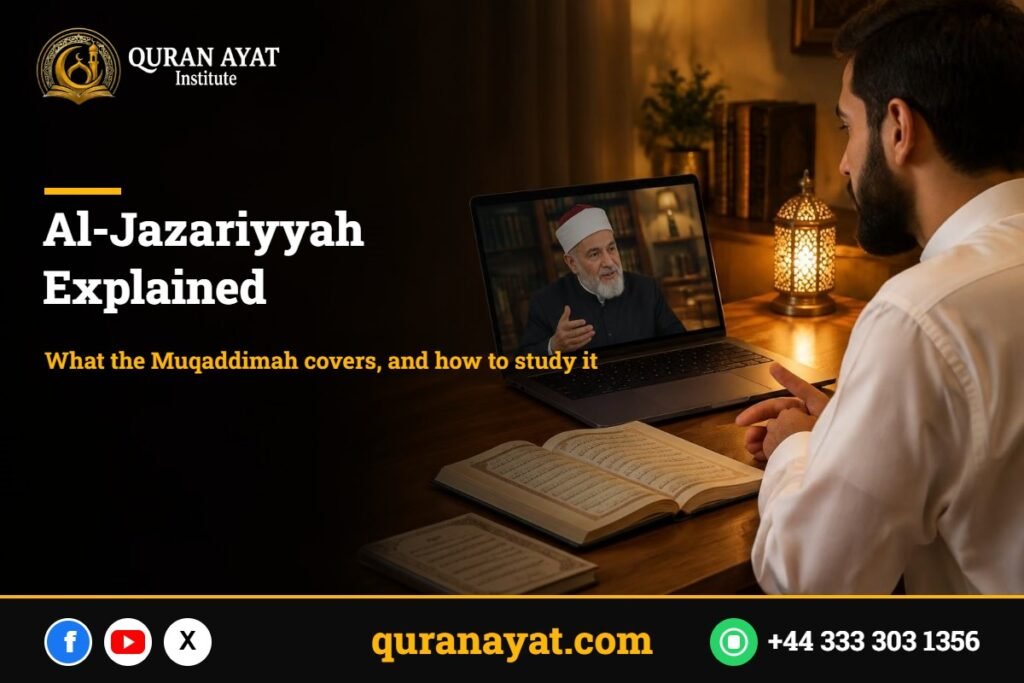
Short answer: Al-Muqaddimah al-Jazariyyah is a tajweed poem of about 107 lines by Imam Muhammad ibn al-Jazari (d. 833 AH), the great scholar of the Quranic readings. It covers what the beginner texts leave out: the exact articulation point of every letter (makharij), the qualities of the letters (sifat), heavy and light letters, the rules of ra and lam, stopping and starting, and how certain words are written in the mushaf. Students usually study it after Tuhfat al-Atfal. It is not a formal condition for an ijazah, but we strongly recommend it before one, so the student knows the complete rules of tajweed. You can study it one to one in our advanced tajweed course.
Key Takeaways
- About 107 lines, by Imam Ibn al-Jazari, the leading authority on the qira’at.
- Focus: makharij, sifat, tafkheem and tarqeeq, waqf, and the spelling of the mushaf.
- Usually studied after Tuhfat al-Atfal.
- Not a strict requirement for an ijazah, but recommended before it.
- Studied by memorising, explaining and applying each line.
Who was Ibn al-Jazari?
Imam Shams al-Din Muhammad ibn al-Jazari was born in Damascus in 751 AH and died in Shiraz in 833 AH. He is the scholar behind Al-Nashr fi al-Qira’at al-‘Ashr, the main reference for the ten readings, and most chains of Quran recitation today pass through him. His Muqaddimah (“Introduction”) was written as the first text a reciter should know before studying the readings, and it has been memorised by reciters for six centuries.
What Al-Jazariyyah covers
| Section | Topic | What you learn |
|---|---|---|
| Introduction | Why tajweed is required | The obligation to recite correctly |
| Makharij al-huruf | Articulation points | Where each of the 29 letters comes from |
| Sifat al-huruf | Letter qualities | Hams, jahr, shiddah, isti’la and the rest |
| Tafkheem and tarqeeq | Heavy and light letters | Including the rules of ra and the lam in “Allah” |
| Letters that need care | Common errors | Letters easily mixed up, like ض and ظ |
| Noon and meem, madd | Review of the main rules | A short, precise summary |
| Waqf and ibtida | Stopping and starting | Where you may stop and where to begin again |
| Maqtu’ and mawsul | Spelling of the mushaf | Words written joined or separate |
| Ta’ marbutah and maftuhah | Spelling of the mushaf | Words written with an open ta’ (ت) |
| Hamzat al-wasl | Connecting hamzah | How to start a word with it |
The first sections fix how each letter sounds. The later sections teach how the mushaf is written and where to stop. Together they turn a good reader into a precise reciter.
Tuhfat al-Atfal vs Al-Jazariyyah
| Tuhfat al-Atfal | Al-Jazariyyah | |
|---|---|---|
| Author | Sulayman al-Jamzuri | Ibn al-Jazari |
| Length | 61 lines | About 107 lines |
| Level | Beginner to intermediate | Intermediate to advanced |
| Main focus | Noon, meem, lam, madd | Makharij, sifat, waqf, mushaf spelling |
| Usual order | First | Second |
If you have not studied the Tuhfah yet, start there. We explain it in Tuhfat al-Atfal explained.
Is Al-Jazariyyah required for an ijazah?
It is not a strict condition, but we prefer that the student takes it before the ijazah, so that he knows the rules of tajweed completely.
An ijazah means a qualified teacher has heard your full recitation and connects you to a chain going back to the Prophet ﷺ. A student who knows the Jazariyyah understands why the teacher corrects each letter, which makes the ijazah reading smoother and the knowledge deeper. If you are working toward one, you can read about our Quran ijazah course and how it is structured.
The Prophet ﷺ said, “The best of you are those who learn the Quran and teach it” (Bukhari 5027). Teaching others correctly starts with knowing the rules precisely.
How we teach the Jazariyyah
As with the Tuhfah, the student memorises the line, the teacher explains it, and then they apply it together in the Quran.
| Step | In the lesson |
|---|---|
| Memorise | One to three lines, with correct pronunciation |
| Explain | Every term, with the rule and its examples |
| Apply | The student finds the rule in the Quran and reads it to the teacher |
| Review | Earlier lines are recited regularly so nothing is lost |
The sections on makharij and sifat need the most practice, because each letter is corrected by ear. This is where one-to-one study is very different from a recorded course: the teacher hears your ض, your ق, your ر, and fixes them in that moment.
Among the teachers who teach the Jazariyyah at Quran Ayat are Ustadha Samah, Ustadha Asmaa Ghareeb and Ustadha Shams, as well as several of our sheikhs. All of our teachers hold an ijazah.
How long does it take?
Most students complete the Jazariyyah in about 3 to 6 months. That is with two or three lessons a week, depending on how quickly they memorise and how much work their letters need. Our student Umair from the UK studied both the Tuhfah and the Jazariyyah with us, and today he is an imam in Manchester.
The path we recommend
- Fluent reading with basic tajweed (Quran tajweed course).
- Tuhfat al-Atfal.
- Al-Muqaddimah al-Jazariyyah.
- A complete khatmah in the recitation course.
- Ijazah reading.
For more on what comes after the basics, see advanced tajweed rules.
Study Al-Jazariyyah online with Quran Ayat
In our advanced tajweed course, you study the Jazariyyah one to one, line by line, with an ijazah-holding teacher who corrects your letters as you go. Lessons fit your schedule, and you can book a free trial so the teacher can check your level first.
Frequently Asked Questions
How many lines is Al-Jazariyyah?
About 107 lines (some editions count 109, depending on the introductory lines).
Who wrote Al-Muqaddimah al-Jazariyyah?
Imam Muhammad ibn al-Jazari (751-833 AH), the leading scholar of the Quranic readings.
Is Al-Jazariyyah harder than Tuhfat al-Atfal?
Yes. It is longer and goes deeper into articulation points and letter qualities, which is why it is usually studied second.
Do I need Al-Jazariyyah for an ijazah?
It is not a strict condition, but we recommend it before an ijazah so you know the full rules of tajweed.
Can I study Al-Jazariyyah online?
Yes. One-to-one online lessons are well suited to it, because the teacher can hear and correct each letter.
Do I have to memorise it?
We teach it by memorising each line and understanding it, then applying it in the Quran.
