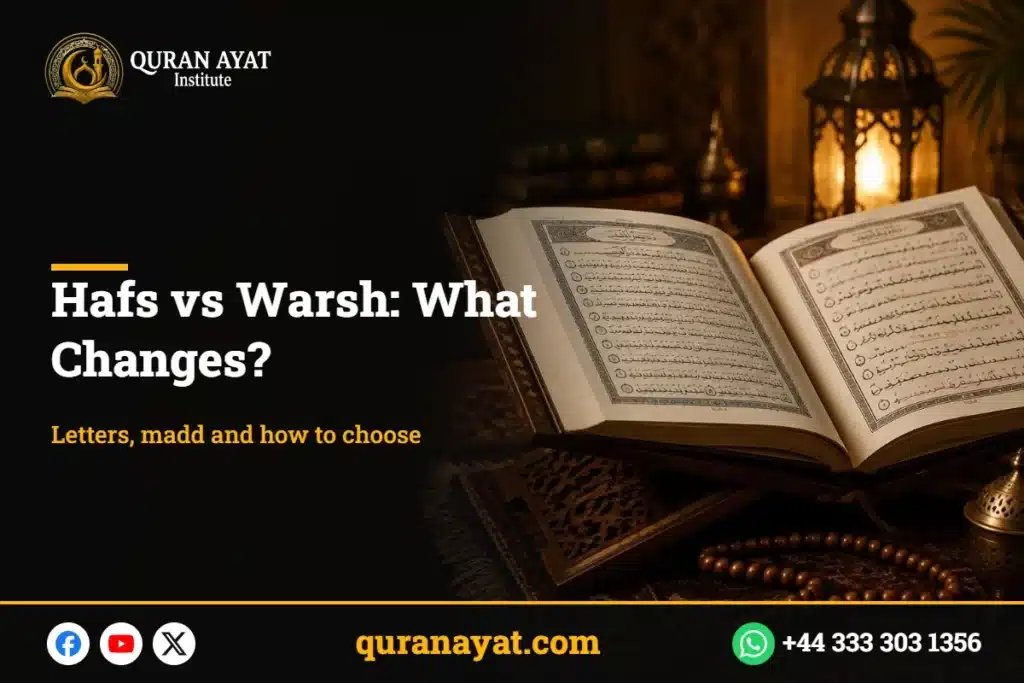
Hafs and Warsh are two authentic transmissions (riwayat) of the same Quran. Hafs passes down the reading of Imam Asim of Kufa, and Warsh passes down the reading of Imam Nafi’ of Madinah. The meaning and message are the same. The differences are mostly in pronunciation: Warsh stretches the long madd to 6 counts, softens or drops many hamzahs, reads some ra letters lighter and some lam letters heavier, and differs from Hafs in a small number of words and in how verses are counted. Hafs is the recitation most Muslims learn today. Warsh is read mainly in North and West Africa. If you want to read both with a teacher who holds an ijazah, our online Qiraat course teaches them step by step.
A common worry among students is that two recitations mean two Qurans. They do not. The Prophet ﷺ said the Quran was revealed in seven ahruf (modes), “so recite whatever is easy for you” (Sahih al-Bukhari 4992). Hafs and Warsh are two of the transmissions scholars preserved from that teaching, each with a full chain back to the Prophet ﷺ.
Some of my students are studying all ten Qiraat with me, not only Hafs or Warsh. One of them is from Morocco and learned to recite in Hafs. At first Hafs was a little hard for him, because Warsh is the recitation people grow up with there. He got used to it, and today, ma sha Allah, his Hafs recitation is precise.
Key Takeaways
- Hafs and Warsh are two authentic riwayat of one Quran. Neither is a different text.
- Hafs comes from Asim (Kufa) through Hafs ibn Sulayman. Warsh comes from Nafi’ (Madinah) through Uthman ibn Sa’id, known as Warsh.
- The biggest differences you hear: longer madd in Warsh, eased hamzah, lighter ra, heavier lam, and taqleel (a slight tilt of the alif sound).
- A few words differ in letters or vowels, such as مَالِكِ / مَلِكِ in Al-Fatihah.
- Learn Hafs well first. Move to Warsh with a qualified teacher, never from audio alone.
Who were Hafs and Warsh?
Each recitation carries three names: the imam (qari) whose reading it is, the student who transmitted it (rawi), and the region where it spread.
| Hafs ‘an Asim | Warsh ‘an Nafi’ | |
|---|---|---|
| Imam (qari) | Asim ibn Abi al-Najud, Kufa (d. 127 AH) | Nafi’ ibn Abd al-Rahman, Madinah (d. 169 AH) |
| Transmitter (rawi) | Hafs ibn Sulayman (d. 180 AH) | Uthman ibn Sa’id al-Misri, “Warsh” (d. 197 AH) |
| Where it is read today | Most of the Muslim world: Middle East, South Asia, Turkey, Southeast Asia, the West | Morocco, Algeria, Mauritania and parts of West Africa |
| Verse counting | Kufan count: 6,236 verses | Madani count: 6,214 verses |
| Long madd (muttasil and munfasil) | 4 to 5 counts (by the Shatibiyyah route) | 6 counts |
Sources for the background: the Wikipedia entry on Warsh and the entry on Asim.
Nafi’s reading has a second famous transmitter, Qalun, read in Libya and parts of Tunisia. Our guide to the Qiraat explains how the ten readings and their twenty transmitters fit together.
The 7 main differences between Hafs and Warsh
1. Length of madd
In Warsh, a long vowel followed by a hamzah is stretched to 6 counts, whether the hamzah is in the same word (جَاءَ) or the next word (بِمَا أُنزِلَ). Hafs usually stretches these 4 or 5 counts. Warsh also lengthens madd al-badal, a long vowel that comes after a hamzah, as in ءَامَنُوا, which Hafs reads with 2 counts only.
2. Easing the hamzah
Warsh changes many hamzahs that Hafs pronounces fully:
- Ibdal (replacing): a silent hamzah becomes a long vowel. يُؤْمِنُونَ is read يُومِنُونَ, and يَأْكُلُونَ is read يَاكُلُونَ.
- Naql (transferring): when a word ends in a silent letter and the next word begins with a hamzah, the hamzah’s vowel moves back and the hamzah drops. قَدْ أَفْلَحَ becomes قَدَ فْلَحَ.
- Tas-heel (softening): in two hamzahs side by side, the second is softened, as in ءَأَنذَرْتَهُمْ.
3. Lighter ra (tarqeeq)
Warsh reads ra lightly in places where Hafs reads it heavy, mostly when it comes after a kasrah or a silent ya. خَبِيرًا and بَصِيرًا are examples.
4. Heavier lam (taghleez)
In Warsh, a lam with fathah after ص, ط or ظ is read heavy. You hear it clearly in الصَّلَاةَ and in ظَلَمُوا. In Hafs, that lam stays light. Only the lam of the name Allah is heavy in Hafs (after a fathah or dammah).
5. Taqleel (a slight tilt of the alif)
Warsh tilts some long alifs slightly toward an “e” sound, a feature called taqleel or imalah sughra. It appears in words ending in alif maqsurah, such as مُوسَى and الْهُدَى. Hafs has only one word with full imalah in the whole Quran: مَجْرٜىٰهَا in Surah Hud 11:41.
6. Silat meem al-jam’
When the plural meem (as in عَلَيْهِمْ) is followed by a hamzah, Warsh joins it with a damma and a long waw: عَلَيْهِمُۥٓ ءَأَنذَرْتَهُمْ. Hafs keeps the meem silent.
7. A few different words
A small number of words differ in letters or vowels. Each is an authentic reading, and the meanings support each other:
| Verse | Hafs | Warsh |
|---|---|---|
| Al-Fatihah 1:4 | مَالِكِ (Owner) | مَلِكِ (King) |
| Al-Baqarah 2:132 | وَوَصَّىٰ | وَأَوْصَىٰ |
| Aal-Imran 3:133 | وَسَارِعُوٓا | سَارِعُوٓا (no waw) |
You can compare Al-Fatihah 1:4 on quran.com, which shows the Hafs text.
Is one recitation better than the other?
No. Both are mutawatir, passed down by so many people in every generation that no error could enter unnoticed. Scholars accept all ten readings and their transmitters. You pray with whichever one you learned correctly.
What matters is that you do not mix them inside one recitation without knowledge. Reading one word in Hafs and the next in Warsh, by guessing, is a mistake. A trained reciter moves between riwayat by rules, and that skill takes study.
Which should you learn first?
For almost every non-Arab student, Hafs comes first. Nearly every mushaf printed outside North and West Africa follows Hafs, so do most apps and most recordings. Once your Hafs recitation is correct, with sound tajweed rules and clear makharij, Warsh becomes a set of changes you add on top, not a new start.
Students from Morocco or Algeria who grew up with Warsh are the exception. Many keep Warsh as their main recitation and learn Hafs second.
From my experience, a student who has mastered Hafs does not need long to complete a full recitation in Warsh: usually around 6 to 7 months, a little less than it took them in Hafs.
How to learn Warsh correctly
- Fix your Hafs first. Weak tajweed in Hafs carries straight into Warsh.
- Use a Warsh mushaf. The script marks the eased hamzahs and madd with special signs. Reading Warsh from a Hafs mushaf leads to mistakes.
- Learn the usool (general rules) before the farsh (word-by-word differences). The usool are the seven points above. The farsh is the list of single words.
- Recite to a teacher who holds an ijazah in Warsh. This is how the reading was passed down for 1,200 years. Audio helps you hear it. It cannot correct you.
- Aim for an ijazah if you want to teach. Our guide to the ijazah in Quran explains how chains work, and our Quran ijazah course prepares you for it.
If you plan to go further, our guide on how to learn the 10 Qirat of the Quran lays out the full path.
Learning Hafs and Warsh with a teacher
In our one-to-one Qiraat classes online, the teacher first checks your Hafs recitation. Then you learn the usool of Warsh with short passages, and only then move to full surahs. Students who need stronger foundations first can join our advanced tajweed course. You can book a free trial class and ask the teacher to assess your level before you choose.
Frequently asked questions
Is the Warsh Quran different from the Hafs Quran? No. It is the same Quran in a different authentic recitation. The differences are in pronunciation and a small number of words, all transmitted from the Prophet ﷺ.
Why do most Muslims read Hafs? Hafs was already widespread in the Ottoman lands, and when the first standard printed mushafs appeared in the 20th century, most followed it. It is now the recitation of the large majority of Muslims.
Can I pray with Warsh if I learned Hafs? Yes, if you have learned Warsh correctly. Do not switch mid-prayer by guessing.
How many verses does the Quran have in Warsh? Warsh follows the Madani count of 6,214 verses. Hafs follows the Kufan count of 6,236. The text is the same. Only the places where verses are divided differ.
What is the difference between Warsh and Qalun? Both transmit the reading of Nafi’. Qalun is closer to Hafs in madd length and keeps more hamzahs. Warsh has longer madd and more easing.
Can I learn Warsh online? Yes. Recitation is taught by listening and correction, which works well one-to-one online. Book a Qiraat course trial to start.
Written by Sheikh Adel Rizk (Abu Ahmad), Quran teacher at Quran Ayat.
