Written by Sheikh Adel Rizk (Abu Ahmad), Quran teacher at Quran Ayat
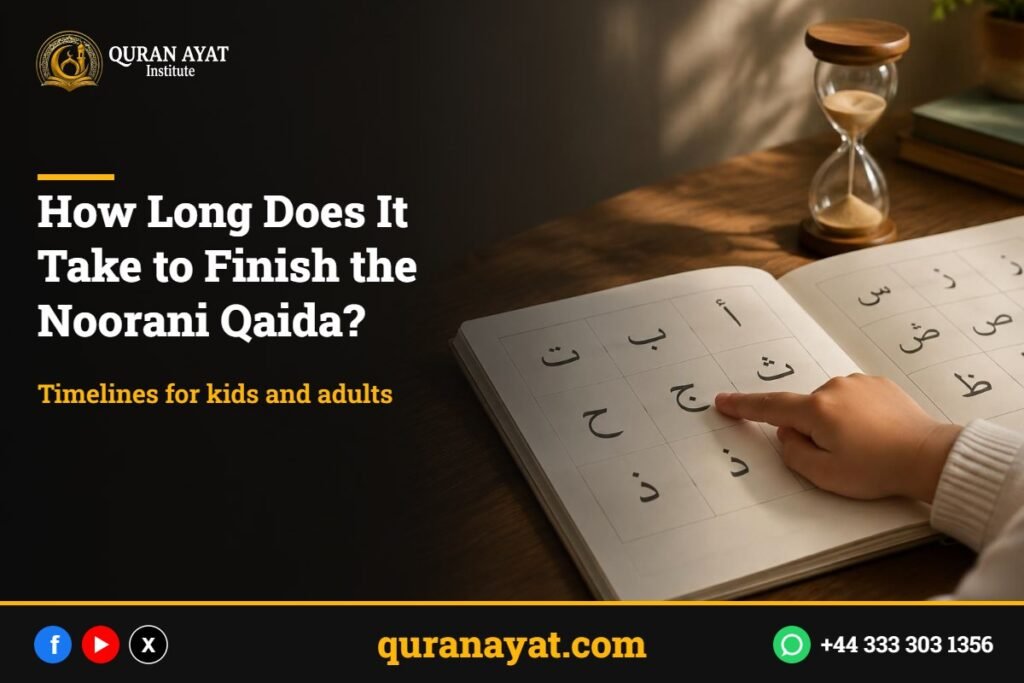
Short answer: Most students, children and adults alike, finish the Noorani Qaida in 3 to 6 months. Where they land in that range depends mainly on how many 30-minute lessons they take each week. Very young children (around 4) who start with only 2 to 3 lessons a week often need a bit longer. The biggest factors are lessons per week, 10 minutes of daily practice, and a teacher who corrects every sound. Our online Noorani Qaida course sets a pace for each student and reports progress after every lesson.
Key Takeaways
- Most children and adults: 3 to 6 months.
- More lessons per week = closer to 3 months.
- Age 4: often a little longer, since lessons start at 2 to 3 a week.
- 3 to 4 lessons a week plus 10 minutes of daily practice is the sweet spot.
- Finishing fast matters less than finishing correctly: the Qaida sets your pronunciation for life.
Noorani Qaida timeline by age
| Learner | Lessons per week | Typical time to finish | Why |
|---|---|---|---|
| Age 4 | 2 to 3 | 6 months or a little more | Short focus; letters learned slowly |
| Ages 5 to 8 | 3 to 4 | 4 to 6 months | Good memory, still learning to focus |
| Ages 9 to 12 | 3 to 5 | 3 to 5 months | Understands explanations |
| Teens and adults | 2 to 3 | 4 to 6 months | Learns rules fast; needs work on sounds |
| Teens and adults | 4 to 5 | about 3 months | Faster pace |
At Quran Ayat, the average is 3 to 6 months, for adults and children alike. The real difference is the number of lessons per week: a student with more weekly lessons finishes closer to three months, and one with fewer lessons closer to six.
What’s in the Qaida (and how long each part takes)
Editions differ slightly, but most follow this order:
| Part | What you learn | Approx. share of total time |
|---|---|---|
| Single letters | 29 letters and their makharij | 15% |
| Joined letters | How letters change shape | 10% |
| Muqatta’at | Letters at the start of surahs | 5% |
| Harakat | Fatha, kasra, damma | 15% |
| Tanween | -an, -in, -un | 10% |
| Madd letters | Long vowels (alif, waw, ya) | 10% |
| Sukoon and leen | Stopping sounds, soft letters | 10% |
| Shaddah | Doubled letters | 10% |
| Combined lessons and tajweed basics | Reading full words and lines | 15% |
The first letters take longest, because each sound must be right before moving on. After harakat, children often speed up.
The lessons where most students slow down
- Huruf muqatta’at: the separate letters at the start of some surahs (like الٓمٓ). Many children find this lesson the hardest, because their breath is still short and they can’t hold the full madd.
- Similar letters: ح and ه, ع and ء, ص and س, ض and د, ق and ك. These need a teacher who hears the difference.
- Joined letters: a letter can look very different at the start, middle or end of a word.
- Shaddah with tanween: many children read it too fast.
- Madd lengths: stretching too short or too long.
The lesson where I see students stop most often is the huruf muqatta’at, like Alif Lam Meem. Their breath is still short, so they can’t stretch the madd to its full length yet. With practice and patience, the breath grows and the lesson becomes easy.
How to finish faster (without rushing)
- Three to four short lessons a week. Better than one long one.
- 10 minutes of daily practice. Read the last lesson aloud to a parent.
- Listen before you read. Hear the teacher, then repeat.
- Don’t skip revision. Read the previous page at the start of every lesson.
- Keep one teacher. They know exactly which sounds need work.
- Praise effort. Children who enjoy the Qaida read more.
The Prophet ﷺ said the Quran “will come on the Day of Resurrection as an intercessor for its companions” (Sahih Muslim 804). Every lesson of the Qaida is a step toward reading it.
Is speed or accuracy more important?
Accuracy. The Qaida is where pronunciation is set. Allah says “and recite the Quran with measured recitation” (Quran 73:4). A child who rushes the Qaida often spends years later fixing the same sounds. A slower, correct Qaida makes the move to the mushaf smooth.
What happens after the Qaida?
Most students move straight to reading short surahs from the mushaf, usually Juz Amma, with a teacher. Some continue with reading Quran basics to build fluency. If you’re still choosing a book, compare Noorani Qaida vs Madani Qaida and Noorani Qaida vs Noor Al-Bayan.
Online or in person?
Both work if the teacher listens closely. Online one-to-one lessons help because the teacher hears only your child, every lesson, and you can sit beside them. Our one-to-one Noorani Qaida lessons are 30 minutes, and parents get a written report after each one.
Frequently asked questions
How many lessons are in the Noorani Qaida?
Most editions have about 17 lessons, from single letters to combined reading.
Can an adult finish the Noorani Qaida in one month?
It is rare. Most adults need 3 to 6 months, depending on lessons per week.
At what age can a child start the Noorani Qaida?
Usually 4 to 5. At Quran Ayat we accept children from age 4.
Is the Noorani Qaida enough to read the Quran?
It gives you the foundation. Reading short surahs with a teacher afterwards builds fluency.
Can I learn the Noorani Qaida by myself?
You can learn the shapes alone, but you need a teacher to correct the sounds.
What if my child gets stuck on one lesson?
That is normal. Slow down, revise, and keep lessons short and positive.
Start the first lesson
Whether your child is 4 or you’re starting at 40, the Noorani Qaida is the door to reading the Quran. Pick a steady pace, practise a little every day, and let a teacher correct every sound. Join our online Noorani Qaida course and book a free 30-minute trial lesson.
