Written by Sheikh Adel Rizk (Abu Ahmad), Quran teacher at Quran Ayat
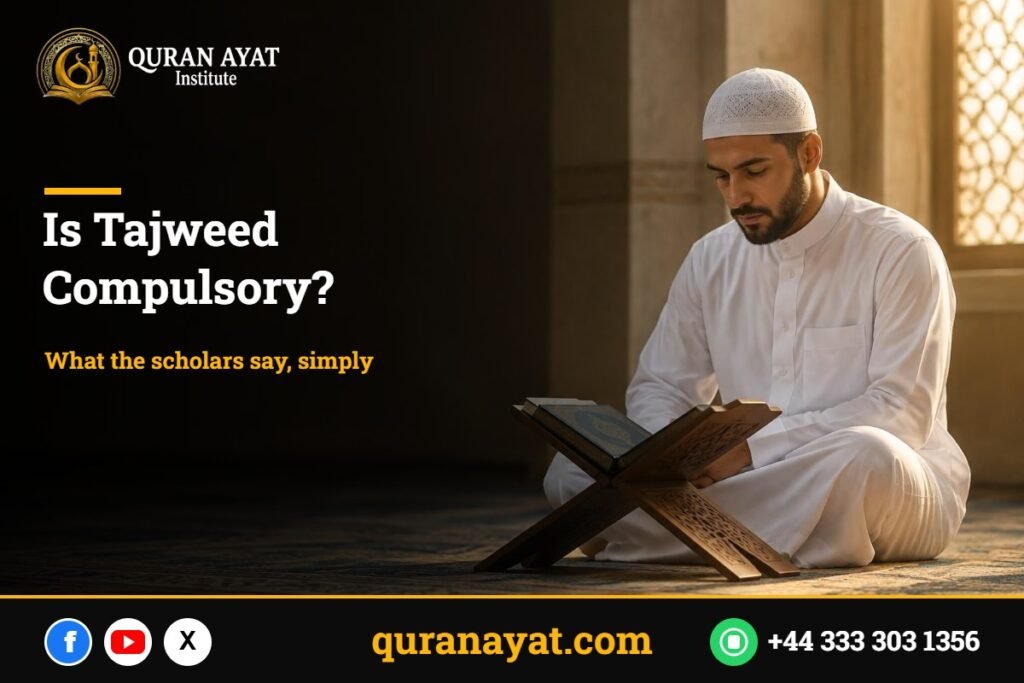
Short answer: Scholars separate two things. Studying the rules of tajweed in detail (their names, letters and definitions) is a communal obligation (fard kifayah): the community needs people who know them. Reciting the Quran without clear mistakes (lahn jali), the kind that change a letter, a vowel or the meaning, is required of every Muslim who recites, as far as they are able. Allah commands, “And recite the Quran with tarteel” (73:4), and tarteel is only correct when every letter is given its right. So yes: reciting with correct tajweed is the goal, and a beginner who is learning is rewarded for the effort. Our online tajweed course helps you reach that goal step by step.
Key Takeaways
- Learning the rules in detail: fard kifayah (communal duty).
- Avoiding clear mistakes (lahn jali) while reciting: required of every reader.
- Hidden mistakes (lahn khafi): should be corrected, especially by those able to.
- The proof: “And recite the Quran with tarteel” (73:4).
- Beginners who struggle are still rewarded; the duty is to keep learning.
What scholars say
Imam Ibn al-Jazari wrote in his famous poem: “Applying tajweed is a firm obligation; whoever does not recite the Quran correctly is sinful.” Scholars explain that this refers to the mistakes that change the Quran’s letters, vowels or meaning. Many fatwa councils give the same summary, for example this answer from Darul Iftaa Jordan.
| Question | Ruling (summary) |
|---|---|
| Must every Muslim know the names and definitions of the rules? | No. It is a communal duty (fard kifayah). |
| Must I avoid clear mistakes when I recite? | Yes, as far as you are able. |
| Must I avoid hidden mistakes? | You should work on them; they are disliked and lower the quality of recitation. |
| Am I sinful while I am still learning? | No. Someone sincerely learning is rewarded for the effort. |
Clear mistakes vs hidden mistakes
| Lahn jali (clear mistake) | Lahn khafi (hidden mistake) | |
|---|---|---|
| What it is | Changing a letter, a vowel, or adding/removing a letter | Missing a finer rule, like ghunnah or madd length |
| Example | Reading ح as ه, or changing a fathah to a dammah | Shortening a 6-count madd, missing an ikhfa |
| Does it change meaning? | Often, yes | Usually not |
| Ruling | Must be avoided | Should be corrected |
Clear mistakes are why everyone needs at least the basics with a teacher. Hidden mistakes are what advanced study fixes.
What we tell students who say tajweed isn’t important
When a student tells me, “I’ll read without tajweed, it doesn’t matter,” I tell him: of course not. Then why did we teach you tajweed? You learned tajweed in order to read with tajweed. How can tajweed not be important? Allah, glorified and exalted, said, “And recite the Quran with tarteel,” and tarteel is not correct unless you give every letter its right and its due (haqquhu wa mustahaqquhu). That is exactly what the science of tajweed means.
“Its right” (haqq) means the letter’s essential qualities, the ones it always has. “Its due” (mustahaqq) means what it takes from the letters around it, like ghunnah, idgham or a heavy sound. Our article on tarteel vs tajweed explains how the two words connect.
If you are a beginner, don’t be discouraged
The Prophet ﷺ said, “The one who is skilled in the Quran will be with the noble, righteous scribes (angels), and the one who recites it and stumbles over it, finding it difficult, will have two rewards” (Muslim 798). Struggling is not a sin. Staying where you are, when you could learn, is the problem.
That is why adults should not feel it is too late. Read is it too late to learn Quran as an adult, then start with a teacher in our Quran classes for adults.
What this means for you in practice
- Learn the basics with a teacher. Correct makharij, short and long vowels, and the main rules remove most clear mistakes.
- Recite to someone. You can’t hear your own mistakes well. A teacher can.
- Keep reading while you learn. Don’t stop reciting until you are “perfect.”
- Build up to the finer rules. Madd lengths, ghunnah and the rest come with time.
- Teach your children early. Our tajweed for kids course builds correct habits from the start.
Learn tajweed with a qualified teacher
In our one-to-one tajweed classes, an ijazah-holding teacher listens to your recitation, starts with the mistakes that matter most, and builds from there at your pace. Book a free trial lesson to get your level checked.
Frequently Asked Questions
Is tajweed fard?
Learning the rules in detail is fard kifayah. Reciting without clear mistakes is required of every reciter, as far as they can.
Is it a sin to read the Quran without tajweed?
Making clear mistakes that change letters or meaning, when you are able to learn, is blameworthy. A sincere learner who is still improving is rewarded, not sinful.
Can I read the Quran if I don’t know tajweed yet?
Yes. Keep reading and learn alongside it. The Prophet ﷺ promised a double reward for the one who struggles.
Do I need to memorise the names of the rules?
No. Applying them correctly is what matters for every reciter. Knowing the names helps, and is required of those who teach.
What is the proof that tajweed is required?
“And recite the Quran with tarteel” (73:4), and the consistent practice of reciting the Quran as it was received from the Prophet ﷺ.
