Written by Sheikh Adel Rizk (Abu Ahmad), Quran teacher at Quran Ayat
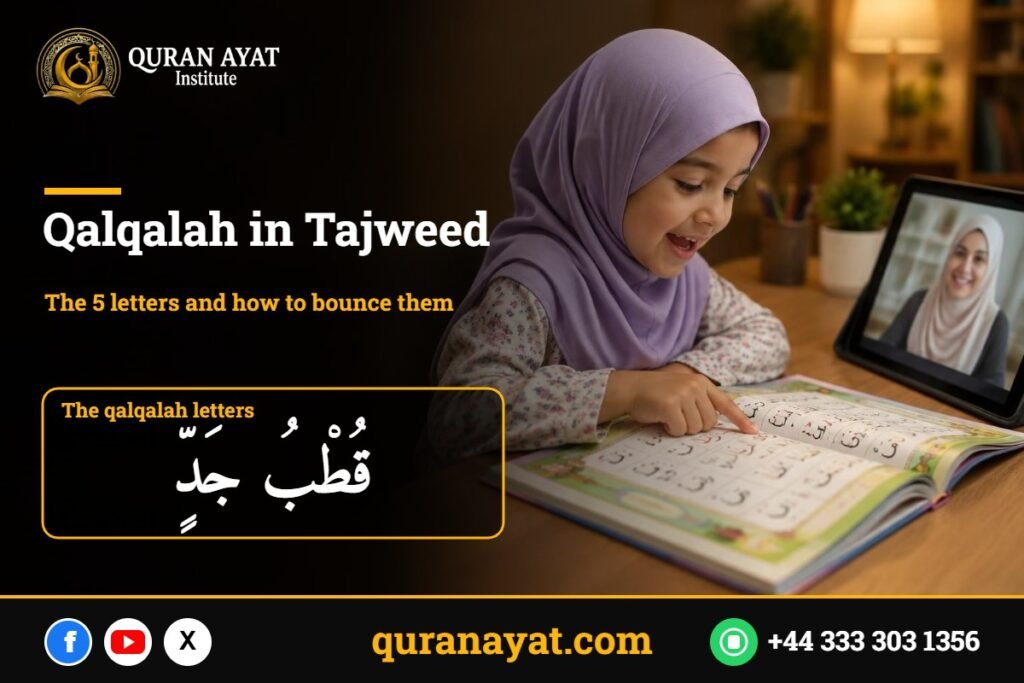
Short answer: Qalqalah (قلقلة) is a light bouncing or echo sound made on five letters, ق ط ب ج د, when they carry a sukoon. The five letters are collected in the phrase قُطْبُ جَدٍّ (qutbu jadd). When one of them is silent, the letter is “released” with a small bounce so it does not get swallowed. The bounce is light in the middle of a word (qalqalah sughra) and stronger when you stop on the letter at the end of a word (qalqalah kubra). It is one of the easiest tajweed rules for children, and it is taught early in our tajweed for kids course.
Key Takeaways
- 5 letters: ق ط ب ج د, remembered as قطب جد.
- Qalqalah happens only when the letter has a sukoon.
- Sughra: in the middle of a word. Kubra: when stopping at the end.
- The bounce must not turn into a vowel (no “a”, “i” or “u” after the letter).
- Children learn it fast by practising the silent letter sound.
What is qalqalah?
The word qalqalah means shaking or disturbance. These five letters are strong letters: the air is fully stopped when you make them. If they are silent and you simply stop the sound, the letter disappears. Qalqalah is the small release that lets the listener hear the letter clearly.
Allah says, “And recite the Quran with measured recitation” (Quran 73:4). Giving each of these five letters its echo is part of that measured recitation.
The 5 qalqalah letters
| Letter | Name | Example with sukoon |
|---|---|---|
| ق | Qaf | الْفَلَقْ (at a stop, 113:1) |
| ط | Ta’ | يَطْمَعُ |
| ب | Ba’ | لَهَبْ (at a stop) |
| ج | Jeem | الْبُرُوجْ (at a stop, 85:1) |
| د | Dal | أَحَدْ (at a stop, 112:1) |
The levels of qalqalah
| Level | When it happens | Strength | Example |
|---|---|---|---|
| Qalqalah sughra (minor) | Silent letter in the middle of a word | Light | يَدْخُلُونَ (110:2) |
| Qalqalah kubra (major) | You stop on the letter at the end of a word | Stronger | أَحَدْ (112:1) |
| Qalqalah akbar (some books) | You stop on a letter with shaddah | Strongest | الْحَقّ (at a stop) |
Many books count only the first two levels. Others add the third for a stopped letter with shaddah. Either way, the idea is the same: the more the letter is stopped on, the clearer the bounce.
How we teach qalqalah to children
For qalqalah we bring the children the sounds of the letters: أقْ، أطْ، أبْ، أجْ، أدْ, and so on. That is the movement we teach them with: the letter is originally silent, and when it is silent it comes out in this way. These are the letters of قطب جد. Honestly, there are not many mistakes in qalqalah; children pick it up well.
Here is the drill in steps:
- Say the letter with a helper hamzah: أقْ, أطْ, أبْ, أجْ, أدْ. The child hears the bounce on the silent letter.
- Move to words: يَدْخُلُونَ, يَطْمَعُ, خَلَقْنَا.
- Stop on short surahs: Al-Ikhlas (أَحَدْ، الصَّمَدْ), Al-Falaq (الْفَلَقْ), Al-Masad (لَهَبْ، وَتَبّْ).
- Check for extra vowels: the bounce is not a “a” sound. “Ahadaa” is wrong; “ahad” with a light echo is right.
For more child-friendly rules, see our guide to tajweed rules for kids.
Common mistakes (and how to fix them)
| Mistake | What it sounds like | Fix |
|---|---|---|
| Adding a vowel | “ahada”, “falaqi” | Keep the mouth neutral after the bounce |
| No bounce at all | The letter disappears | Practise أقْ أطْ أبْ until the release is natural |
| Bouncing on a voweled letter | Echo on قَ or بِ | Qalqalah is only for the silent letter |
| Too strong in the middle | A heavy jump inside the word | Keep sughra light |
Qalqalah and the other early rules
Children usually learn qalqalah together with the natural madd and the noon and meem rules. If you want the next step, read our guide to the types of madd in tajweed and the noon sakinah and tanween rules.
A tip for parents
You don’t need to know tajweed to help. Ask your child to recite Al-Ikhlas and listen for the end of each line: you should hear a clear, short echo on the د in أَحَدْ and الصَّمَدْ. If you hear “ahadaa”, ask the teacher to work on it in the next lesson.
Learn qalqalah with a teacher
In our tajweed for kids classes, the teacher drills each letter with your child one to one, then applies it in the surahs they are memorising. Adults learn the same rules in our Quran tajweed course. Every teacher holds an ijazah, and the first lesson is a free trial. Book it for your child through the tajweed for kids course page.
Frequently Asked Questions
What are the 5 letters of qalqalah?
ق ط ب ج د, collected in the phrase قطب جد (qutbu jadd).
When does qalqalah happen?
Only when one of the five letters carries a sukoon, either written in the middle of a word or because you stop on it.
What is the difference between qalqalah sughra and kubra?
Sughra is the light bounce on a silent letter in the middle of a word. Kubra is the stronger bounce when you stop on the letter at the end of a word.
Is qalqalah hard for children?
No. It is one of the easiest rules. Children learn it quickly by practising the silent letter sound (أقْ، أطْ، أبْ).
Does qalqalah add a vowel after the letter?
No. The bounce is a release, not a vowel. Adding “a” or “i” after the letter is a mistake.
