Written by Sheikh Adel Rizk (Abu Ahmad), Quran teacher at Quran Ayat
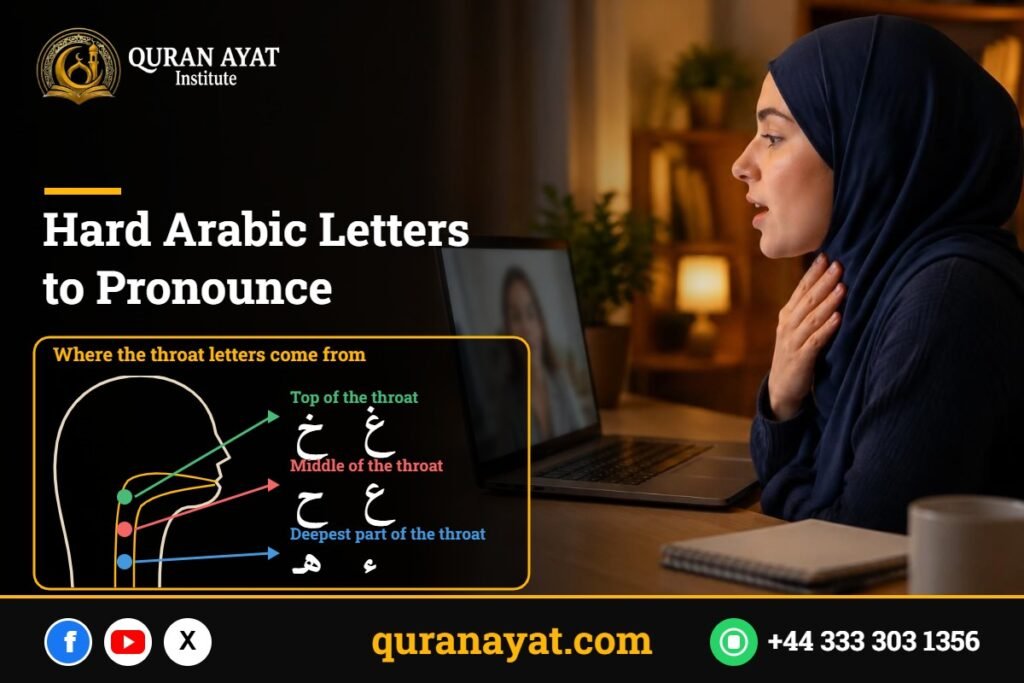
Short answer: The Arabic letters that English speakers find hardest are the ones English does not have: ع (‘ayn), ح (ha), خ (kha), غ (ghayn), ق (qaf), ض (dad), ص (sad), ط (ta) and ظ (dha). Most of them come from the throat or are “heavy” letters said with the back of the tongue raised. The usual mistake is replacing them with the nearest English sound: ص becomes س, ض becomes د, ح becomes ه. The fix is to learn where each letter comes from and practise it slowly with a teacher who can hear you. You can do this from the first lesson in our reading Arabic course.
Key Takeaways
- The hardest letters are the throat letters (ع ح خ غ) and the heavy letters (ص ض ط ظ ق).
- ع and ح both come from the middle of the throat.
- Most mistakes are swaps with an easier letter: ص to س, ض to د, ح to ه.
- A letter is fixed by its place (makhraj), not by copying a sound you half-heard.
- Fix them early; a wrong letter in the Quran can change the meaning.
Why some Arabic letters are hard
English uses the lips, teeth and front of the mouth for most sounds. Arabic uses the whole length of the throat and mouth, from the deepest part of the throat to the lips. A letter that comes from a place you have never used in your own language will feel strange at first. That is normal, and it is not a sign that you are “bad at languages”.
The second reason is weight. Arabic has heavy letters, said with the back of the tongue raised toward the roof of the mouth, and each one has a light “twin” that sounds close to English. If you do not raise the tongue, the heavy letter turns into its light twin. We explain heavy and light letters in tafkheem and tarqeeq.
The hard letters at a glance
| Letter | Where it comes from | Usual mistake | Quick tip |
|---|---|---|---|
| ع (‘ayn) | Middle of the throat | Dropped, or said like a plain vowel | Tighten the middle of the throat and let the voice pass |
| ح (ha) | Middle of the throat | Said like ه (soft h) | The breathy sound after eating something very spicy |
| خ (kha) | Top of the throat | Said like k | A light scraping sound, like clearing the throat softly |
| غ (ghayn) | Top of the throat | Said like g | The voiced version of خ, close to a gargle |
| ق (qaf) | Back of the tongue against the soft palate | Said like ك (k) | Deeper than k, with the tongue further back |
| ض (dad) | Side of the tongue against the upper molars | Said like د (d) | Heavy, with the side of the tongue doing the work |
| ص (sad) | Tip of the tongue near the lower front teeth | Said like س (s) | Same place as س, but heavy, with the tongue raised |
| ط (ta) | Tip of the tongue against the gum ridge | Said like ت (t) | A heavy, full t |
| ظ (dha) | Tip of the tongue between the teeth | Said like ذ or ز | The heavy version of ذ |
| ه (ha) | Deepest part of the throat | Dropped at the end of a word | Keep a clear breath, even at the end |
The throat letters: ع and ح
ع and ح both come from the middle of the throat. For the ح, I tell students: it is the sound you make after you eat something hot and spicy, that strong breath from the throat.
The difference between them is the voice. ح is pure breath with no voice. ع has the voice in it, and the throat is tighter. A simple drill:
- Say a long “aaa”.
- Keep the sound going and tighten the middle of the throat. That is ع.
- Now do the same with breath only, no voice. That is ح.
Practise them in pairs from the Quran: الْحَمْدُ (al-hamd) and الْعَالَمِينَ (al-‘alamin), both in Quran 1:2.
The heavy letters: ص, ض and ق
These are where we hear the most mistakes.
The mistakes I hear most from students: ص becomes س, ض becomes د, and sometimes, but not often, ق becomes ك.
Each of these swaps can change a word completely. صَبْر (patience) said with a س sounds like a different word, and the same is true for many pairs in the Quran. That is why we treat these letters as a priority, not a detail.
- ص and س: Say س, then raise the back of your tongue and round the mouth slightly without moving the tip. The sound becomes fuller. That is ص.
- ض and د: ض is not made at the front of the mouth like د. The side of the tongue presses against the upper back teeth (left, right or both). Practise with وَلَا الضَّالِّينَ at the end of Quran 1:7.
- ق and ك: Both are made with the back of the tongue, but ق is deeper, near the uvula, and heavy. Say ك, then move the point of contact further back.
How to practise the hard letters
| Step | What to do |
|---|---|
| 1. Hear it | Listen to a teacher or a teaching recitation (Mushaf al-Mu’allim) say the letter alone |
| 2. Place it | Learn where it comes from and feel that place |
| 3. Pair it | Practise it next to the letter you usually confuse it with: ص/س, ض/د, ح/ه, ق/ك |
| 4. Word it | Read short Quran words that contain it |
| 5. Check it | Read to a teacher; fix it before it becomes a habit |
The last step is the one people skip. You cannot hear your own mistake easily, because your ear is trained on your own language. A teacher hears it at once. In our reading Arabic course, the teacher corrects each letter in the lesson, and you get a short report after every lesson that lists the letters to practise.
How long until they sound right?
Most students get the shape of the hard letters in the first few weeks, and make them natural over the following months of reading. For the full timeline of learning to read, see how long it takes to learn to read Arabic. If you are starting from the very beginning, the Noorani Qaida course builds every letter one by one.
Why it matters for the Quran
In everyday speech, people may understand you even with a wrong letter. In the Quran, each letter must be given its right, and swapping ص for س or ض for د is a clear mistake that can change the meaning. Getting the letters right is the first step of tajweed; the rules come after. When your letters are clear, continue with our Quran tajweed course.
Learn the hard letters with a teacher
Book a free trial in our reading Arabic course. The teacher will listen to you read, tell you which letters need work, and give you a simple plan to fix them.
Frequently Asked Questions
What is the hardest Arabic letter to pronounce?
For most English speakers it is ض (dad) or ع (‘ayn). ض needs the side of the tongue, and ع comes from the middle of the throat, two places English never uses.
What is the difference between ح and ه?
ح comes from the middle of the throat and has a strong breath, like the sound after eating something very spicy. ه comes from the deepest part of the throat and is much softer, like the English h.
Why does my ص sound like س?
Because the back of your tongue is not raised. ص is made in the same place as س but is heavy; raise the back of the tongue and the sound becomes full.
Is ق the same as ك?
No. ق is made further back, near the uvula, and is heavy. ك is lighter and further forward.
Can I learn these letters from an app?
An app can let you hear them, but it cannot hear you. Most learners need a teacher to tell them when the letter is right.
How long does it take to pronounce Arabic letters correctly?
The shape of each letter usually comes in a few weeks; making it natural takes a few months of regular reading.
