Written by Sheikh Adel Rizk (Abu Ahmad), Quran teacher at Quran Ayat
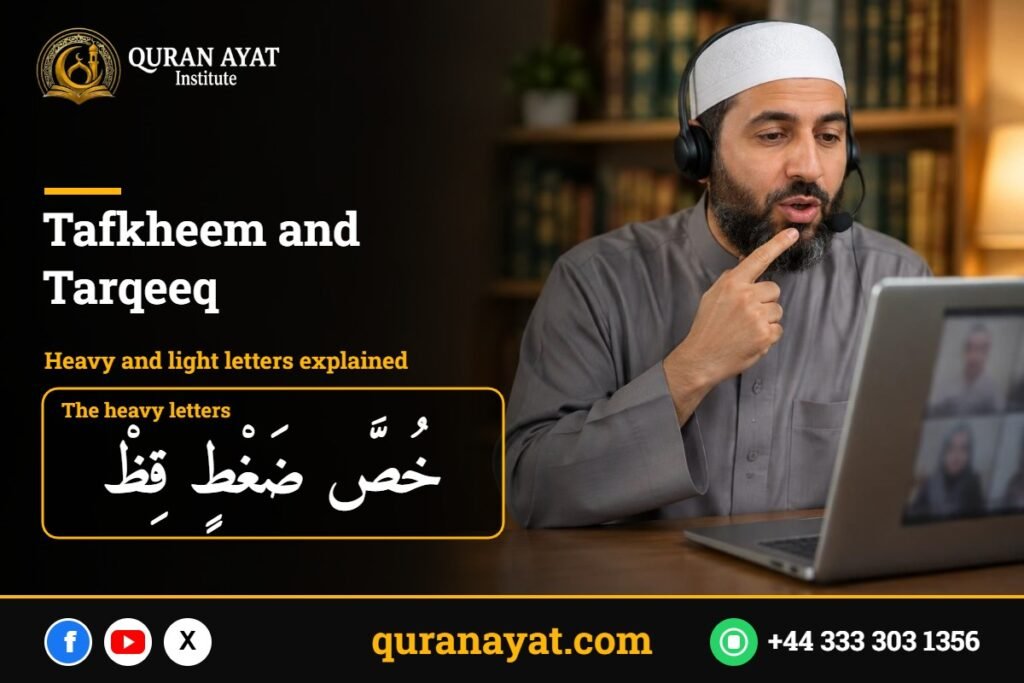
Short answer: Tafkheem means making a letter heavy (full, deep sound, with the back of the tongue raised), and tarqeeq means making it light. Seven letters are always heavy: خ ص ض غ ط ق ظ, collected in the phrase خُصَّ ضَغْطٍ قِظْ. Most other letters are always light. Three cases change: the letter ر, the lam in the name “Allah”, and the alif, which follows the letter before it. For non-Arab students, the most common problem is reading a heavy letter as its light “twin”: ص as س, ض as د, and sometimes ق as ك. Our advanced tajweed course works on these letters one by one.
Key Takeaways
- Always heavy: خ ص ض غ ط ق ظ (خص ضغط قظ).
- Always light: most other letters.
- Sometimes heavy, sometimes light: ر, the lam of “Allah”, and alif.
- Common learner mistakes: ص → س, ض → د, ق → ك.
- Heaviness changes the meaning: سَيْف (sword) vs صَيْف (summer).
Why heavy and light letters matter
In Arabic, some letters differ only in heaviness. Swap one for the other and you change the word: سَيْف (sword) and صَيْف (summer), قَلْب (heart) and كَلْب (dog). In the Quran, this kind of change is a clear mistake (lahn jali). That is why tafkheem and tarqeeq come early in serious tajweed study.
The three groups of letters
| Group | Letters | Rule |
|---|---|---|
| Always heavy (isti’la) | خ ص ض غ ط ق ظ | Always tafkheem |
| Always light | All other letters except the three below | Always tarqeeq |
| Sometimes heavy, sometimes light | ر, the lam of لفظ الجلالة, ا | Depends on the vowel or the letter before |
The rules for ر (ra)
| Heavy (tafkheem) | Light (tarqeeq) |
|---|---|
| Ra with fathah or dammah: رَبِّ، رُزِقُوا | Ra with kasrah: رِجَال |
| Silent ra after fathah or dammah: مَرْيَم، قُرْآن | Silent ra after kasrah: فِرْعَوْن |
| Silent ra at a stop after ي: خَبِيرْ |
There are a few more details (for example, a silent ra after kasrah followed by a heavy letter, as in قِرْطَاس, stays heavy). Your teacher will cover them as they come up in your reading.
The lam in “Allah”
- Heavy after fathah or dammah: قَالَ اللَّهُ، رَسُولُ اللَّهِ.
- Light after kasrah: بِسْمِ اللَّهِ، الْحَمْدُ لِلَّهِ (1:2).
- Heavy at the start of a sentence: اللَّهُ الصَّمَدُ.
Example: قُلْ هُوَ اللَّهُ أَحَدٌ (112:1) has a heavy lam because هُوَ ends with a fathah.
The mistakes we hear from non-Arab students
The letters non-Arab students sometimes make light when they should be heavy are mostly ض and ق, and ص as well. The ص comes out as س, the ض as د, and with some students the ق becomes ك, but that last one is not very common.
| Heavy letter | Often read as | Practice pair |
|---|---|---|
| ص | س | صَيْف / سَيْف |
| ض | د | ضَلَّ / دَلَّ |
| ق | ك (less common) | قَلْب / كَلْب |
| ط | ت | طِين / تِين |
| ظ | ذ or ز | ظَلَّ / ذَلَّ |
How we fix it: read the pair slowly, light letter first, then the heavy one. For the heavy letter, raise the back of the tongue toward the roof of the mouth, keep the lips slightly rounded, and let the sound fill the mouth. The teacher listens and repeats until the difference is clear. For ض, which has no equivalent in English, this takes the longest; the correct articulation is taught in detail in Al-Jazariyyah.
The levels of tafkheem
Heavy letters are not all equally heavy. A heavy letter with fathah followed by alif (قَال) is heaviest; with fathah (قَ) slightly less; with dammah (قُ) less; with kasrah (قِ) the least. You don’t need to memorise the levels to start, but a trained ear hears them, and they are part of the advanced level.
Practice routine
- Read the pairs in the table, five times each, every day for a week.
- Find heavy letters in Al-Fatihah. الصِّرَاطَ is a great word: ص and ط heavy, ر heavy.
- Read Surah Al-Ikhlas and listen for the heavy lam in اللَّهُ.
- Record yourself and compare with a reciter.
- Read to a teacher. These sounds are learned by ear, not from text.
Students who are still learning the letters themselves should start with our Reading Quran basics course. And since heavy and light letters also affect the ghunnah, see our guide to ghunnah in tajweed.
Learn heavy and light letters with a teacher
In our advanced tajweed course, an ijazah-holding teacher works on your heavy letters one at a time, with practice pairs and your own recitation, until ص, ض and ق sound right. Beginners start with the Quran tajweed course. Book a free trial to get your letters checked.
Frequently Asked Questions
What are the heavy letters in tajweed?
Seven letters are always heavy: خ ص ض غ ط ق ظ, collected in خُصَّ ضَغْطٍ قِظْ.
When is ra heavy and when is it light?
Ra is heavy with fathah or dammah, and light with kasrah. A silent ra follows the vowel before it, with a few exceptions.
Is the lam in “Allah” always heavy?
No. It is heavy after fathah or dammah and light after kasrah, as in بِسْمِ اللَّهِ.
Why do non-Arabs read ص like س?
Because English has no heavy “s.” Practising pairs like صَيْف / سَيْف with a teacher fixes it.
Is reading a heavy letter as light a serious mistake?
Yes, when it turns one letter into another (ص into س), it can change the meaning, which is a clear mistake (lahn jali).
