

Written by Sheikh Adel Rizk (Abu Ahmad), Quran teacher at Quran Ayat
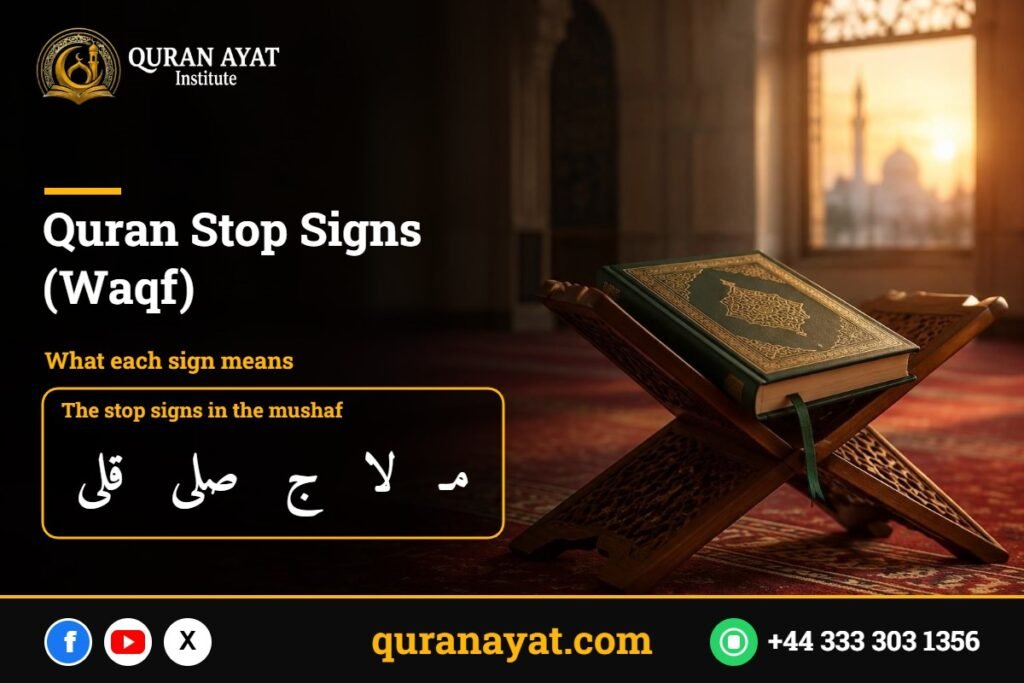
Short answer: The small symbols above the lines of the Quran tell you where you may stop (waqf) and where you should continue. In the Madinah mushaf used by most readers: مـ means you must stop, لا means do not stop here, ج means stopping and continuing are equal, صلى means continuing is better, قلى means stopping is better, and ∴ ∴ (two sets of three dots) means stop at one of the two places but not both. The sign students misread most is قلى. These signs protect the meaning of the verse, which is why they are taught in every online tajweed course.
Key Takeaways
- مـ = stop (lazim). لا = don’t stop.
- ج = stopping and continuing are equal.
- صلى = continuing is better. قلى = stopping is better.
- ∴ ∴ = stop at one of the two, not both.
- When you stop, don’t start again from a place that breaks the meaning.
Why stop signs matter
Ali ibn Abi Talib, may Allah be pleased with him, explained tarteel in “And recite the Quran with tarteel” (73:4) as “giving the letters their tajweed and knowing the places of stopping.” Stopping in the wrong place can join two sentences that should be separate, or cut a sentence in a way that changes its meaning. The signs were added by scholars to guide readers who don’t know Arabic grammar.
The stop signs at a glance
| Sign | Name | Meaning | What to do |
|---|---|---|---|
| مـ | Waqf lazim | Necessary stop | Stop; continuing could change the meaning |
| لا | Waqf mamnu’ | Not permitted here | Don’t stop; if you must, go back and start before it |
| ج | Waqf ja’iz | Permissible | Stop or continue, both are fine |
| صلى | Al-wasl awla | Continuing is better | Prefer to continue |
| قلى | Al-waqf awla | Stopping is better | Prefer to stop |
| ∴ ∴ | Waqf mu’anaqah | Embracing stop | Stop at the first or the second, not both |
| | End of verse | Verse ends | Stopping is recommended (Sunnah) |
The sign students get wrong: قلى
The waqf signs are mostly fine with students. But the sign قلى: students sometimes don’t know its ruling.
The confusion is understandable: قلى and صلى look alike and both are “allowed,” but they point in opposite directions.
| صلى | قلى | |
|---|---|---|
| Stands for | الوصل أولى (continuing is better) | الوقف أولى (stopping is better) |
| Is stopping allowed? | Yes | Yes |
| Is continuing allowed? | Yes | Yes |
| Which is preferred? | Continuing | Stopping |
A simple way to remember: ق is the first letter of قِف (stop), so قلى leans toward stopping. ص comes from وَصْل (connecting), so صلى leans toward continuing.
The “three dots” (mu’anaqah)
When you see three dots (∴) in two nearby places, you may stop at the first or the second, but not at both. A well-known example is at the start of Surah Al-Baqarah: ذَٰلِكَ الْكِتَابُ لَا رَيْبَ ۛ فِيهِ ۛ هُدًى لِّلْمُتَّقِينَ (2:2). Stopping after لَا رَيْبَ or after فِيهِ is fine, but stopping at both would leave فِيهِ alone and break the meaning.
Stopping and starting again (waqf and ibtida)
Knowing where to stop is half of it. The other half is where to begin again:
- Start from a place that makes sense. If you stopped in the middle of a sentence, go back a word or two so the meaning is complete.
- Never start right after a لا sign. Go back to before it.
- When you stop, the last letter becomes silent. A final vowel turns into sukoon, and fathatain becomes a long “a.” Our guide to the types of madd explains the madd ‘arid that this creates.
- Running out of breath is allowed. If you stop in an awkward place because you had to breathe, go back and continue from a sensible point.
The deeper rules of stopping are a full chapter in Al-Jazariyyah, and are practised in our Quran recitation course.
How to practise
- Read with a pencil. Circle every sign on one page and write what it means.
- Listen to a reciter. Notice where he stops and why.
- Use the قلى and صلى trick (ق = قف, ص = وصل) until it is automatic.
- Read to a teacher. They will stop you when a pause changes the meaning.
Learn waqf with a teacher
Stopping well makes your recitation sound natural and keeps the meaning intact. In our one-to-one tajweed classes, the teacher shows you every sign as it appears in your reading and corrects your stopping and starting. Book a free trial to start.
Frequently Asked Questions
What does مـ mean in the Quran?
A necessary stop (waqf lazim). Stop there, because continuing could change the meaning.
What does لا mean in the Quran?
Do not stop here. If you have to stop, go back and start again from before it.
What is the difference between قلى and صلى?
Both allow stopping or continuing. قلى means stopping is better; صلى means continuing is better.
What do the three dots mean?
Waqf mu’anaqah: stop at one of the two marked places, not both.
Is it a sin to stop at the wrong place?
Not usually, unless it is done deliberately in a way that changes the meaning. The goal is to learn the signs so your recitation keeps the meaning clear.
