Written by Sheikh Adel Rizk (Abu Ahmad), Quran teacher at Quran Ayat
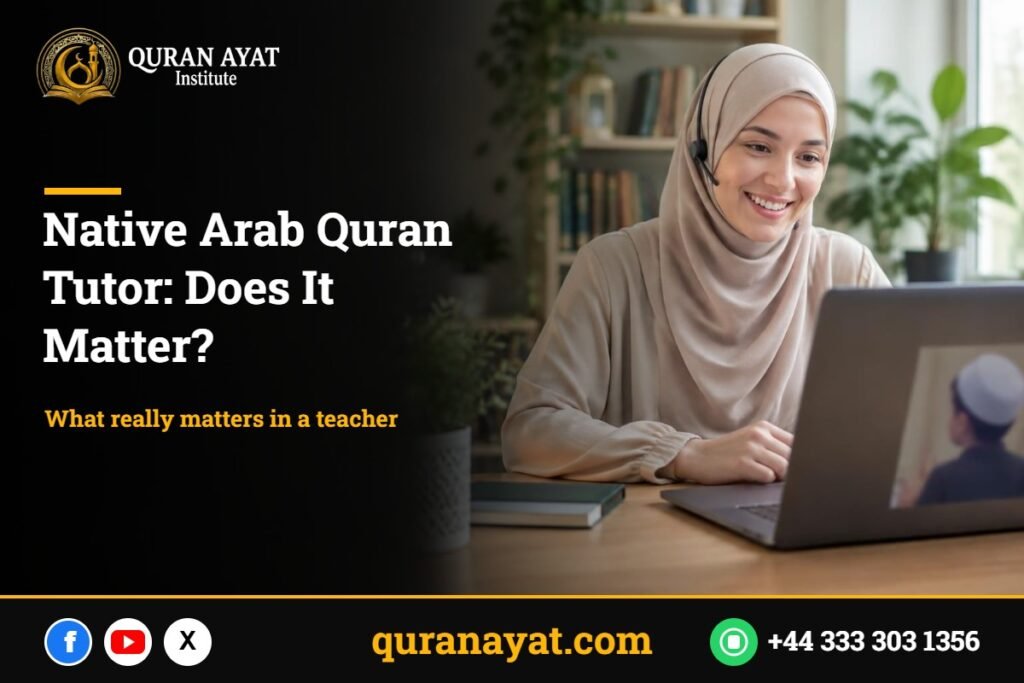
Short answer: You don’t strictly need a native Arab tutor to learn the Quran: what you need is a teacher with an ijazah, correct makharij (articulation of the letters) and the ability to explain clearly in your language. But a native Arabic speaker has a real advantage: Arabic is their mother tongue, so the sounds of the letters, the heavy and light letters and the meaning of the words come naturally, and they hear small mistakes instantly. At Quran Ayat, our teachers are mostly native Arabic speakers from Egypt; every one holds an ijazah, and every one passed an English teaching test. You can try one free in our Quran classes for adults.
Key Takeaways
- Non-negotiable: an ijazah and correct makharij.
- A native Arab tutor’s advantage: natural pronunciation and understanding of the words.
- Equally important: clear English explanation.
- Many excellent non-Arab teachers exist; check qualifications, not just origin.
- Every Quran Ayat teacher is tested in recitation, tajweed, explaining tajweed, and English.
What a native Arab tutor brings
The background is that I am Arab; I read Arabic to begin with; it is my mother tongue. A teacher without that Arabic background may not have all of it, and even when he knows the rules, his makharij may not be as precise. The Egyptian is Arab, with Arab roots going back to when Islam came to Egypt from the Arabian Peninsula.
In practice, this shows up in three places:
| Area | Why a native speaker helps |
|---|---|
| Makharij | Letters like ض, ع, ح, ق and the heavy letters are part of their everyday speech |
| Hearing mistakes | They notice a ص that sounds like س immediately, because it changes the word |
| Meaning | They understand the words they are teaching, which helps with stopping in the right places and explaining |
Allah says, “Indeed, We have sent it down as an Arabic Quran so that you may understand” (12:2). Learning from someone who lives in that language connects you more closely to it. For more on how much Arabic you need yourself, read how much Arabic you need to understand the Quran.
What matters even more than being Arab
Being a native speaker is not enough on its own. Plenty of Arabs recite with mistakes, and many non-Arab teachers are excellent. These are the things to check first:
- An ijazah. A chain of teachers back to the Prophet ﷺ, and proof that a qualified teacher heard their full recitation.
- Correct makharij. Listen to them recite in the trial lesson.
- Clear explanation in your language. A perfect reciter who can’t explain is hard to learn from.
- Reliability. On time, every time. See the red flags to avoid.
How we test every teacher
We interview every teacher. We test them in the Quran, in tajweed, and in explaining tajweed. If they hold an ijazah, we also test them on the mutashabihat (similar verses). And of course we test their English: they have to explain a lesson, for example tafkheem and tarqeeq, in English in front of us, so we can see their style and the tools they use. Our teachers’ English is excellent.
| Test | What we check |
|---|---|
| Quran recitation | Accuracy and makharij |
| Tajweed | Knowledge of the rules |
| Explaining tajweed | Can they teach it, not just do it? |
| Mutashabihat (for ijazah holders) | Precision in similar verses |
| English teaching demo | A live lesson in English, e.g. on heavy and light letters |
And before any of this: no ijazah, no interview. We turn down candidates every day whose recitation is correct but who don’t hold one.
Arab tutor vs non-Arab tutor: a fair comparison
| Native Arab tutor | Non-Arab tutor | |
|---|---|---|
| Makharij | Natural | Learned; excellent in good teachers |
| Understanding of the words | Native | Depends on their Arabic study |
| Shared culture with you | Less, usually | Sometimes more |
| English | Varies; test it in the trial | Often native-level |
| What to check | Ijazah + English | Ijazah + makharij |
The best answer is a teacher who has both: native Arabic and strong English. That is the profile we hire for. If you’d like to know more about Egyptian teachers specifically, read why learn Quran with an Egyptian tutor.
Try a native Arab tutor for free
At Quran Ayat, our teachers are mostly native Arabic speakers, and every one holds an ijazah and passed an English teaching test. Book a free trial in our Quran classes for adults, or for your child in our online Quran classes for kids. If your goal is correct pronunciation, start with tajweed.
Frequently Asked Questions
Do I need an Arab teacher to learn the Quran?
Not strictly. You need a teacher with an ijazah and correct makharij. A native Arab teacher has a natural advantage in pronunciation and understanding.
Why are Egyptian Quran teachers popular?
Egypt has a long tradition of Quran recitation and teaching, many teachers trained in the Azhari system, and Arabic is their native language.
Can a native Arab tutor teach in English?
Yes, if they are tested for it. Every Quran Ayat teacher gives a live English teaching demo before being hired.
What is more important: being Arab or having an ijazah?
The ijazah. Being a native speaker is a strong advantage, but the ijazah is the minimum.
How can I check a tutor’s pronunciation?
Take a trial lesson and ask them to recite a passage with letters like ض, ص, ع and ح. Listen for clear, distinct sounds.
